The Great Smoky Mountains National Park is the most visited national park in the United States, with more than 12 million visitors a year. Most of them come for the scenery and the wildlife. Relatively few come specifically for the birds, which means the people who do come specifically for the birds get something unusual: one of the richest avian habitats in eastern North America, covering more than 500,000 acres of old-growth forest, without much competition.
The park's bird list runs to 240+ species, driven by an elevation range that starts below 900 feet and tops out at 6,643 feet on Clingmans Dome. That vertical spread produces three completely different forest communities, each with its own resident bird community. A single day in the Smokies can take you from warbler-packed cove hardwood forest to boreal spruce-fir habitat where you would expect to be in Canada.
This guide covers three specific locations that collectively represent all three elevation zones: Alum Cave Bluffs for mid-elevation Appalachian hardwood forest, Andrews Bald for high-elevation spruce-fir forest and open bald, and Cades Cove for lowland meadow and edge habitat.
Why the Great Smoky Mountains Are a World-Class Birding Destination
The Smokies sit at the convergence of two distinct forest systems. The southern Appalachian hardwood forest, dominated by tulip poplar, red maple, yellow birch, and American beech, supports a dense community of nesting warblers, vireos, and thrushes at middle elevations. Above 4,500 feet, it transitions into red spruce and Fraser fir, a boreal community more characteristic of New England and Canada than the American South. This is where the Dark-eyed Juncos breed, where Golden-crowned Kinglets sing from spruce boughs year-round, and where Common Ravens patrol the ridgelines.
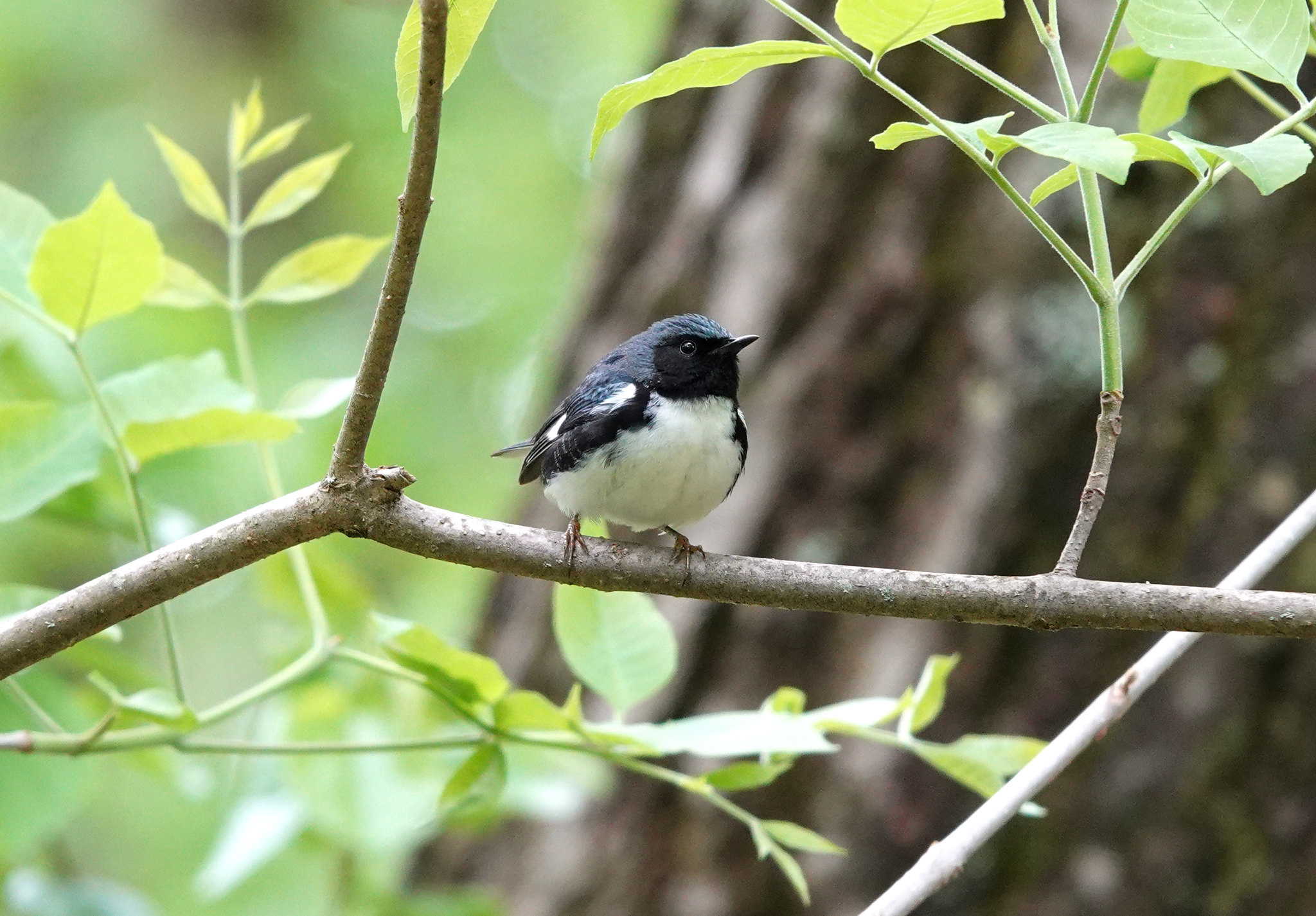
The park is also a critical nesting ground for the Black-throated Blue Warbler, one of the most visually striking warblers in North America and one whose population in the southern Appalachians has been closely monitored for decades. The Smokies hold some of the densest nesting concentrations of this species anywhere in its range. Early research on Black-throated Blue Warbler breeding ecology was conducted here, making the park scientifically significant in addition to aesthetically remarkable.
eBird shows the park region with thousands of submitted checklists and regular documentation of 170+ species per year. The park is designated as a Globally Important Bird Area by Audubon.
When to Go: Great Smoky Mountains Birding by Season
🌸 Spring (Apr–Jun)
Peak birding season. Neotropical migrants arrive from late April through mid-May. By mid-May, warblers are at maximum density and activity throughout the park. Alum Cave Trail is exceptional for Black-throated Blue, Canada, and Black-throated Green Warblers. Cades Cove meadows fill with Indigo Bunting and Eastern Meadowlark. June is quieter but breeding birds are still singing.
☀️ Summer (Jun–Aug)
Breeding season continues through June. High-elevation trails like Andrews Bald offer spruce-fir species and cooler temperatures when the valleys are hot. Wood Thrush song fills the cove hardwood forest through July. Crowds peak in summer, so early morning starts are essential. Cades Cove is best on Wednesday and Saturday mornings when the loop road is closed to cars until 10am.
🍂 Fall (Sep–Oct)
Fall migration brings raptor movement along the ridges and sparrow diversity in the meadows and edges. Cades Cove is productive for White-throated Sparrow, Song Sparrow, and migrating flickers and thrushes. Broad-winged Hawk migration passes through in September. Foliage peaks in mid-October, creating spectacular scenery alongside solid birding.
❄️ Winter (Nov–Mar)
Quieter but rewarding. Cades Cove holds year-round Wild Turkey flocks, Eastern Bluebird, Eastern Towhee, and Carolina Wren. Winter finch irruptions occasionally bring Purple Finch and Red Crossbill to high elevations. The Sugarlands Visitor Center area is good for wintering sparrows. Crowds drop dramatically, and the forest structure is visible without foliage.
Trail 1: Alum Cave Bluffs Trail
Distance: 4.6 miles round-trip | Difficulty: Moderate | Elevation Gain: 1,154 ft | AllTrails Rating: 4.6/5 (13,263 reviews) | eBird Hotspot L942829
The Alum Cave Bluffs Trail starts at the Alum Cave Trailhead on Newfound Gap Road (US-441), about 8.5 miles from the Sugarlands Visitor Center. It follows Alum Cave Creek through cove hardwood forest before climbing through rhododendron tunnels to the bluffs. The trail name refers to alum-rich overhanging rock formations rather than a cave, but the destination matters less than what you encounter along the way.
The creek corridor at the trail's start is outstanding for Louisiana Waterthrush: a warbler that walks along streambanks and bobs its tail while foraging, arriving from South America in late March before most other migrants. The cascades of Alum Cave Creek hold the distinctive warbler from early spring through summer. Listen for its loud, clear song above the sound of moving water.
The mid-elevation hardwood forest along the first two miles is where the density of nesting warblers becomes remarkable. Black-throated Blue Warbler males sing from mid-story perches in the understory, their buzzy ascending "zee-zee-zee-ZEE" carrying through the trees. Black-throated Green Warbler sings from higher in the canopy. Ovenbird calls "teacher-teacher-TEACHER" from the leaf litter. Scarlet Tanager males, flame red against green foliage, are regular in the upper canopy from May through August.
The Canada Warbler is the highlight for many birders, a Species of Conservation Concern with a necklace of black streaks across its bright yellow breast. It favors dense rhododendron thickets and shrubby understory, and the Alum Cave Trail provides ideal habitat in exactly the sections most visited. Look for it where the trail passes through thicker vegetation near stream crossings.
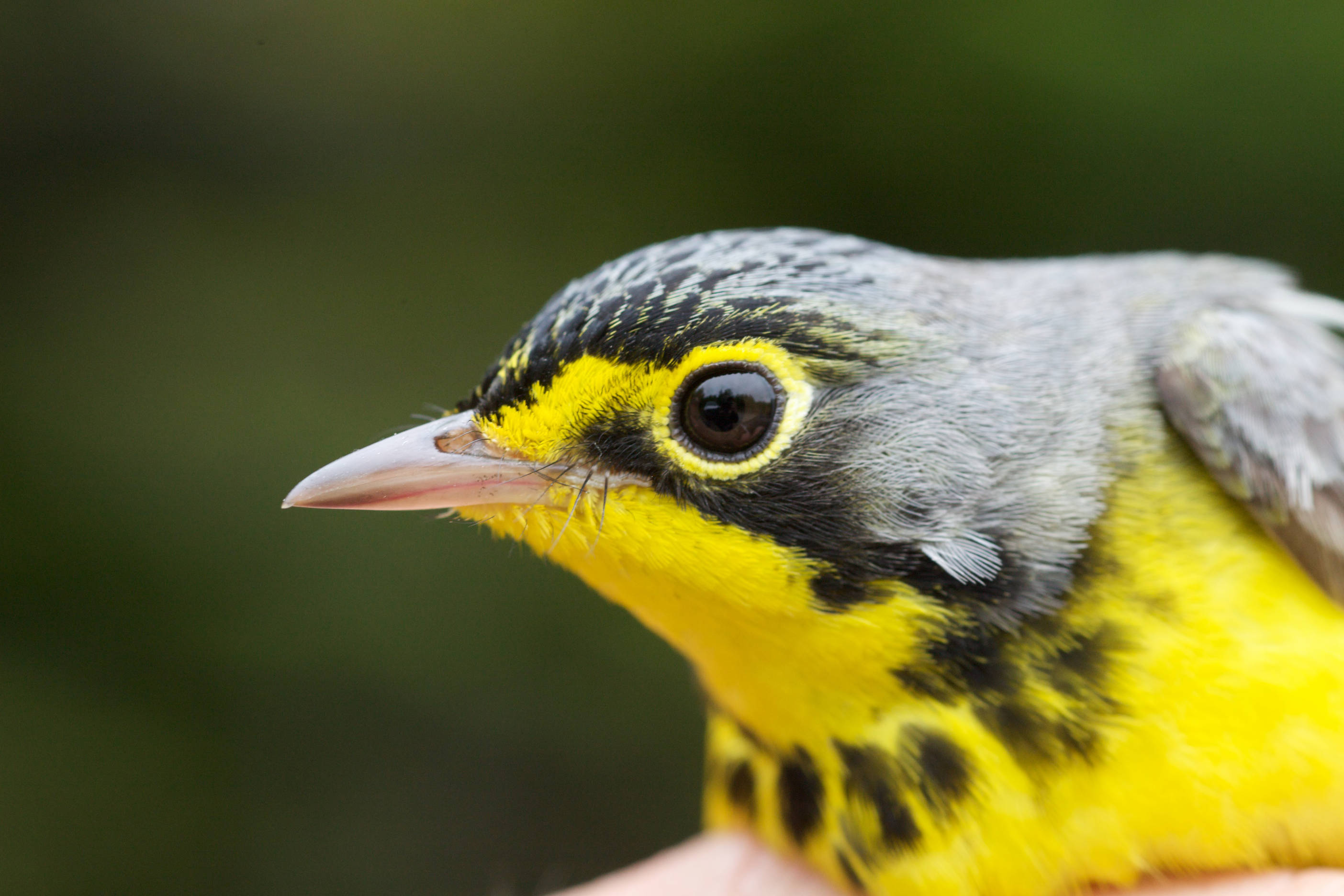
Canada Warbler, a Species of Conservation Concern and one of the signature birds of the Alum Cave Trail. Photo: Ryan Hagerty / Public Domain — USFWS
Wood Thrush song floats through the cove hardwood forest from mid-April through July: one of the most celebrated sounds in American birding, a flute-like spiral of notes that seems to come from everywhere and nowhere simultaneously. The Great Smoky Mountains hold strong breeding populations of this declining species. As the trail climbs above 3,500 feet, the forest shifts and Red-breasted Nuthatch and Dark-eyed Junco begin to appear.
Practical notes: The Alum Cave Trailhead is one of the most popular in the park. Parking fills by 9am on weekends from May through October. Arrive before 8am or take the park shuttle from the Sugarlands Visitor Center. The trail is well-maintained but has some rock hopping at stream crossings. No entrance fee for the trail itself; the park charges no general admission.
Best months: April through mid-June (peak warbler activity); late August through September (fall migration)
Trail 2: Andrews Bald via Forney Ridge Trail
Distance: 3.6 miles round-trip | Difficulty: Moderate | Elevation Gain: 872 ft | AllTrails Rating: 4.7/5 (3,669 reviews) | eBird Hotspot L741761
Andrews Bald sits at 5,860 feet on the Forney Ridge, accessible from the Clingmans Dome parking area on the Tennessee/North Carolina state line. The 1.8-mile trail descends into dense red spruce and Fraser fir forest before opening into the bald, a grassy opening maintained by park management as part of the Appalachian balds ecosystem. The entire route is above 5,000 feet, placing you firmly in boreal forest territory.
At this elevation, the bird community shifts dramatically from the cove hardwood forests below. Dark-eyed Junco is the most abundant species: the "Appalachian" subspecies breeding here has brighter pink flanks than the slate-colored form familiar in winter across most of the eastern United States. Juncos are on every section of the trail, singing from low spruce branches and foraging on the trail surface. They are year-round residents at this elevation.
Golden-crowned Kinglet is equally consistent: tiny, hyperactive, and easier to hear than see, their high-pitched "see-see-see" calls come from the densest spruce boughs. Winter Wren delivers one of the longest and most complex songs of any North American bird from the mossy understory of the spruce-fir forest, an improbable cascade of notes from a bird barely larger than a golf ball.
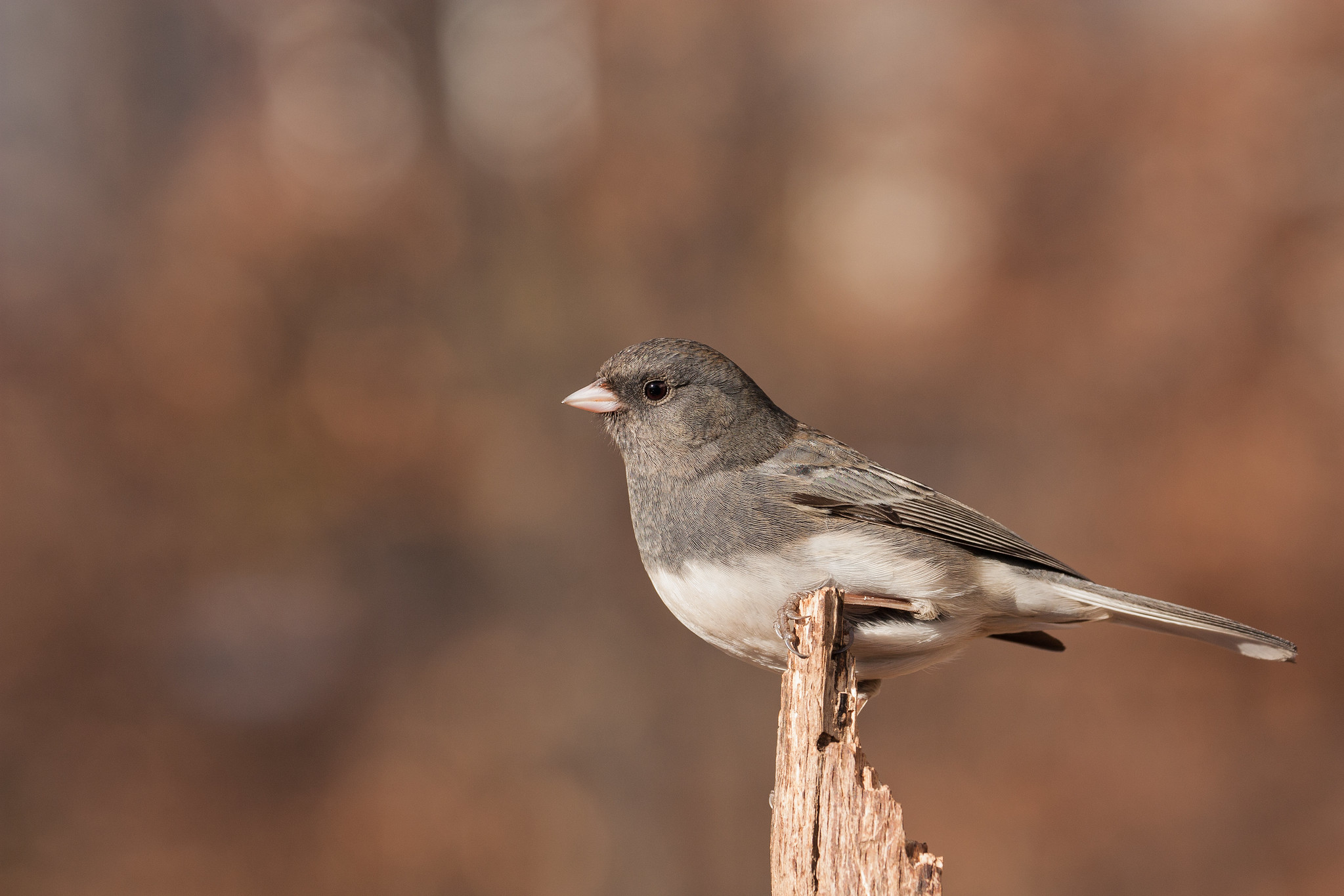
Dark-eyed Junco, the characteristic breeding bird of the high-elevation spruce-fir forest above 5,000 feet. Photo: Mike Carlo / Public Domain — USFWS
Common Raven is regular overhead along the Forney Ridge, its deep croaking calls distinct from the American Crow found at lower elevations. Ravens are year-round residents at high elevations in the Smokies, their large size and wedge-shaped tail easy to distinguish from crows once seen in comparison. The bald opening at the trail's end offers the best opportunity to watch them soaring on ridge thermals.
Veery sings its spiraling descending song from the forest edges near the bald. Least Flycatcher chips from the shrubby margins. Red-breasted Nuthatch creeps down spruce trunks throughout the trail. The combination of spruce-fir forest and open bald at the end makes this route one of the most reliably productive in the park for birds that require high elevation.
Practical notes: Clingmans Dome Road (the access road to the trailhead parking area) is closed from November through March. During peak season, the parking area fills early. The road itself offers birding pullouts with views into the spruce-fir forest. A free park shuttle runs from the Sugarlands Visitor Center to Clingmans Dome on summer weekends. Temperatures at elevation are 10-15 degrees cooler than the valley and can drop sharply if clouds move in. Bring layers regardless of the forecast.
Best months: May through September (full access); June is optimal for breeding bird activity
Trail 3: Cades Cove Loop Road
Distance: 10.5 miles loop | Difficulty: Easy | Elevation Gain: 734 ft | AllTrails Rating: 4.6/5 (2,728 reviews) | eBird Hotspots L2962391 and L2506618
Cades Cove is a broad, open valley at 1,800 feet in the western Tennessee section of the park, encircled by mountains that block the horizon in every direction. It is the most visited destination in the most visited national park in the country, and for birding purposes it is also the most accessible. The 11-mile one-way loop road through the cove passes through open meadows, forest edge, creek corridors, and the ruins of historic farmsteads, covering more habitat variety in a single drive than most parks offer in their entirety.
Wild Turkey is the bird most likely to greet you at Cades Cove. Flocks of 10 to 30 birds are routine in the open meadows, often feeding within feet of the road at dawn and throughout cooler mornings. The turkeys at Cades Cove are accustomed to vehicles and offer extended observation opportunities. Tom turkeys in spring display full fans and gobbling that carries across the whole cove.
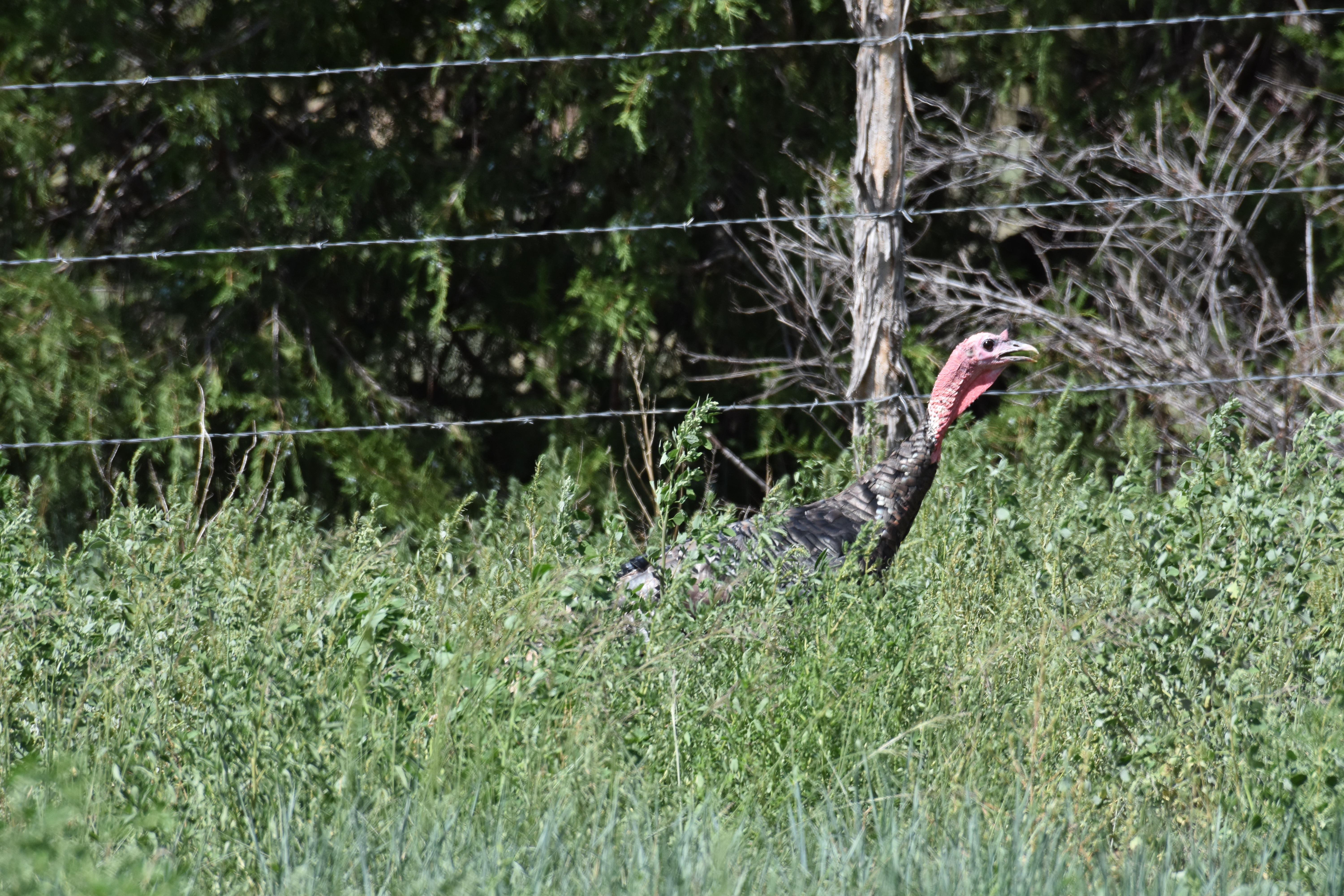
Wild Turkey in Cades Cove meadow. Flocks are year-round and often visible from the loop road at close range. Photo: Anna Weyers Blades / Public Domain — USFWS
The meadow edges and fence lines hold Eastern Bluebird year-round, their vivid blue and orange standing out against the grass. Indigo Bunting males sing from treetops throughout the cove from May through July, the electric blue of breeding males unmistakable in good light. Eastern Meadowlark sings its whistled phrases from fence posts in the open sections, a species in broader regional decline that remains regularly seen at Cades Cove.
The forest edges and creek corridors along the loop add species absent from the open meadow. Pileated Woodpecker calls loudly from the tall trees near Abrams Creek, the largest woodpecker in North America at crow-size, its rectangular excavations visible on fallen logs throughout the bottomland forest. Eastern Towhee calls "drink-your-TEA" from dense shrubs along the road edge. Red-tailed Hawk hunts the open meadows year-round, and Barred Owl calls from the wooded sections after dark.
The loop road is open for motor vehicles most of the year, but on Wednesday and Saturday mornings it is restricted to cyclists and pedestrians until 10am. For birders, these mornings are the best: slower movement, no car noise, and better chances of hearing owl calls in the first hour after dawn. Abrams Falls (a 5-mile round-trip spur from the loop) adds Louisiana Waterthrush and American Dipper (rare but recorded) along the creek.
Practical notes: Cades Cove Loop Road is accessed from the Townsend entrance of the park. The loop is one-way and can back up severely in summer afternoons when wildlife (deer, black bear, turkey) stops traffic. Early morning is faster and more productive for birds. Parking is available at multiple pullouts. Restrooms at the visitor center and campground. The loop takes 1.5 to 4 hours depending on traffic and stops.
Best months: March through June (breeding birds); October (fall raptor movement and foliage); year-round for Wild Turkey
Signature Species of the Great Smoky Mountains
🦜 Birds You'll Likely See
Planning Your Trip
Getting there: The main Tennessee entrance is through Gatlinburg via US-441 (Newfound Gap Road), which connects to Cherokee, NC on the North Carolina side. The Alum Cave Trailhead is 8.5 miles from the Sugarlands Visitor Center on US-441. Clingmans Dome Road branches from US-441 near Newfound Gap. Cades Cove is accessed from the Townsend, TN entrance via TN-73. Knoxville, TN is about 45 miles from Gatlinburg. Asheville, NC is about 60 miles from the Cherokee entrance.
Parking and access: Great Smoky Mountains National Park charges no general entrance fee, making it one of the few major national parks that is free to enter. However, a $5 parking tag (Smokies Adventure Pass) was introduced in 2023 for day use vehicles at developed trailheads and is available at the park website or on-site kiosks. Clingmans Dome Road parking fills quickly from May through October on any day that is not rainy.
What to bring: The mid-elevation Alum Cave Trail is accessible in regular hiking shoes. Andrews Bald is always cooler than the valley, and afternoon thunderstorms are common from May through August. Bring a rain layer regardless of the morning forecast. A good pair of binoculars is essential in the dense forest, where birds are heard more easily than seen. A Merlin Bird ID installation helps identify the layered warbler songs at Alum Cave.
eBird resources: The park region eBird page at Great Smoky Mountains National Park shows aggregated sightings. Targeted hotspots: Alum Cave Trail (L942829), Clingmans Dome/Kuwohi area (L741761), Cades Cove Loop (L2962391), Cades Cove (L2506618).
Other southeast birding: The Smokies pair well with other southeastern destinations. For wetland and shorebird contrast, see the Florida Everglades birding guide. For Atlantic coast migrants and urban birding, see the NYC birding guide. For a completely different ecosystem, the Texas Hill Country guide covers the Edwards Plateau's endemic species.
Warbler identification strategy at Alum Cave: The trail packs as many as 10 warbler species into a 2-mile stretch, and many are easier to hear than see in the dense canopy. Download the Merlin Bird ID app with Sound ID enabled before your visit. Walk slowly, stop often, and let the app identify the overlapping songs. Once you know which species are present, you can focus binoculars on the right section of the canopy. Black-throated Blue Warbler favors the shrub layer 10 to 20 feet off the ground; Black-throated Green Warbler sings from higher in the canopy.
Frequently Asked Questions
What birds can I see at Alum Cave Bluffs in the Great Smoky Mountains? The Alum Cave Trail is exceptional for warblers: Black-throated Blue, Canada, Black-throated Green, and Hooded Warblers all breed in the mid-elevation forest. Wood Thrush, Scarlet Tanager, Ovenbird, and Louisiana Waterthrush are also reliable. Higher sections add Red-breasted Nuthatch and Dark-eyed Junco. April through mid-June is peak season.
What is Andrews Bald and why is it good for birding? Andrews Bald is a grassy opening at 5,860 feet, reached via a 3.6-mile round-trip trail from the Clingmans Dome parking area. The spruce-fir forest along the trail holds boreal species rare at lower elevations: Dark-eyed Junco, Golden-crowned Kinglet, Winter Wren, and Veery. Common Raven is regular overhead. The open bald at the end is surrounded by mature spruce and fir and offers views of the ridgeline.
Is Cades Cove good for birding? Yes. Cades Cove is one of the most productive birding locations in the park, combining open meadow, forest edge, and creek habitat accessible entirely by road. Wild Turkey is abundant year-round. Eastern Bluebird, Indigo Bunting, Eastern Meadowlark, and Red-tailed Hawk are regular in the meadows. The loop is best on Wednesday and Saturday mornings when vehicle traffic is restricted until 10am.
When is the best time to go birding in the Great Smoky Mountains? May through mid-June is the peak for warbler activity and overall species diversity. April brings the earliest neotropical migrants. Fall migration runs August through October. Winter is quieter but produces year-round residents and occasional irruptive finches at high elevation.
How many bird species have been recorded in Great Smoky Mountains National Park? The park list stands at 240+ recorded species. The elevation range from 875 to 6,643 feet, combined with the convergence of northern boreal and southern hardwood forest, produces exceptional diversity. eBird shows consistent year-round activity, with the highest checklists from Cades Cove, the Sugarlands area, and the Clingmans Dome corridor.
Photo Credits
- Hero image: Black-throated Blue Warbler. Photo by Erin Huggins/USFWS. Public Domain.
- Inline image 1: Canada Warbler. Photo by Ryan Hagerty/USFWS. Public Domain.
- Inline image 2: Dark-eyed Junco. Photo by Mike Carlo/USFWS. Public Domain.
- Inline image 3: Wild Turkey. Photo by Anna Weyers Blades/USFWS. Public Domain.