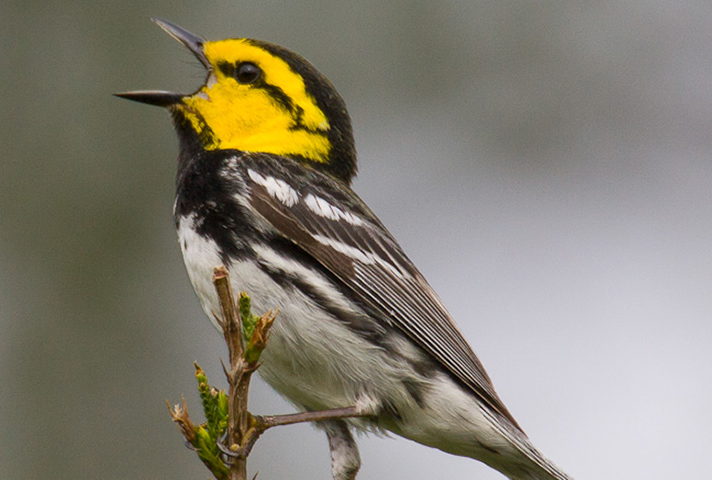
The Golden-cheeked Warbler builds its nest from strips of Ashe juniper bark. This is not a minor detail. The bark is what holds the nest together: the bird peels long, fibrous strips from the aging outer bark of old-growth Ashe juniper trees, weaves them into a tight cup, and lines the cup with animal hair and spider silk. No other material will do. No other tree produces bark with the right fibrous texture. Which means this warbler can only breed where mature Ashe juniper-oak woodland exists. Which means it can only breed in one place on Earth: the Edwards Plateau of Central Texas.
This makes it the only bird species in the United States with a breeding range entirely confined to a single state. When it leaves in July, it flies south to pine-oak forests in Mexico and Central America for the winter. When it returns in late February, it comes back to exactly this 33-county stretch of juniper-covered limestone hills, the Texas Hill Country. The region is not one of its habitats. It is the only habitat.
Three trails in this guide put you in the middle of that landscape, along with a supporting cast of Painted Buntings, Vermilion Flycatchers, Canyon Wrens, and the now-delisted Black-capped Vireo, once federally Endangered and removed from that list in 2018 after decades of targeted conservation effort. This is Central Texas birding at its most specific, and its most rewarding.
Why the Texas Hill Country Is One of North America's Most Distinctive Birding Destinations
The Edwards Plateau, the limestone highland that defines the Hill Country, creates birding opportunities that exist nowhere else on the continent. Its juniper-oak woodland is the exclusive breeding ground for two species that were once heading toward extinction; its canyon habitats hold specialties from Canyon Wrens to Green Kingfishers; its open country hosts Painted Buntings in concentrations that genuinely startle first-time visitors accustomed to finding them one at a time.
The Balcones Canyonlands NWR eBird hotspot at Doeskin Ranch has recorded 245+ species across its varied habitat. Lost Maples State Natural Area carries a park bird checklist exceeding 200 species in its remote Sabinal River canyon. Pedernales Falls State Park documents 150+ species in the limestone river corridor and juniper uplands within 45 miles of Austin. Together, the three trails in this guide cover open savanna grassland, Ashe juniper-oak woodland, limestone canyon, spring-fed creek, and river corridor (the full spectrum of Hill Country terrain) across a route that connects naturally for a two- or three-day visit from Austin or San Antonio.
For Texas birders who have focused on the Gulf Coast, this guide turns the lens inland to the state's most endemic-rich birding destination. For out-of-state visitors, the Hill Country offers the singular draw of a bird found nowhere else on Earth during breeding season. This guide pairs well with our coverage of other breeding-season specialties in the Michigan Lower Peninsula, home to Kirtland's Warbler (another endangered species tied to a single habitat type), and the Pacific Northwest, which shares the Hill Country's emphasis on habitat-specific resident species over migration spectacle.
Trail 1: Indiangrass, Rimrock, and Creek Loop at Balcones Canyonlands NWR (Burnet County)
A 3.9-mile loop through the Doeskin Ranch unit of Balcones Canyonlands NWR, the refuge's most accessible and most visited birding location. The trail crosses open Indiangrass prairie, climbs to Rimrock limestone outcrops with views across Lake Travis and the Hill Country, and descends through mature Ashe juniper-oak woodland along Cow Creek. A dedicated Shin Oak Observation Deck along the route is purpose-built for warbler viewing in the canopy of the scrub oaks just below the ridge. The terrain is the terrain of the Golden-cheeked Warbler: cedar glade, rocky draw, mixed juniper-oak. This is the site.
Balcones Canyonlands NWR was established in 1992 with one explicit purpose: prevent the extinction of two birds. The refuge's 27,000+ acres of Edwards Plateau limestone were purchased and protected specifically as breeding habitat for the Golden-cheeked Warbler and the Black-capped Vireo, both federally listed at the time of the refuge's founding. The Warbler remains on the Endangered Species List. The Vireo was delisted in 2018, a genuine conservation recovery story driven in part by the habitat protection this refuge provides, though it remains state-listed in Texas. The refuge is their stronghold, and Doeskin Ranch is the front door.
The loop begins in open Indiangrass prairie (scan early for Painted Buntings, Dickcissels, Scissor-tailed Flycatchers, and Eastern Meadowlarks in the breeding season), then climbs onto the Rimrock with panoramic views, then descends through the juniper-oak mix where warblers breed. The Shin Oak Observation Deck, positioned in a saddle of scrub oak between cedar glades, is the focal point. Stop here, stand still, and wait. Golden-cheeked Warblers forage actively in the oak canopy at this elevation and frequently come within close range of observers who are patient. Males in breeding plumage (black-and-white face pattern, gold cheek stripe) are striking at any distance; at 15 feet in morning light they are extraordinary.
The Doeskin Ranch eBird hotspot reflects the site's breadth: 245+ species across all seasons, driven by its position at the intersection of juniper woodland, open grassland, and riparian creek. Spring mornings from late March through May are the peak window. Males arrive from their Mexican wintering grounds in late February to early March and sing actively through June. Arrive by 7 am on a still April morning and you can hear multiple males on territory from the same vantage point on the Rimrock trail. The Black-capped Vireo, which favors younger, shorter scrub oak than the warbler, is most reliably found in the low-shin-oak areas on the upper loop, where the bird's rapid, scold-phrase song can be heard before the bird reveals itself in the foliage.
🦜 Species to Watch For at Balcones Canyonlands NWR
💡 Pro Tip: Golden-cheeked Warblers are most vocal and most visible in the two hours after sunrise from late March through mid-May. Walk the loop counterclockwise (clockwise takes you uphill through prairie first, saving the best warbler habitat for mid-morning when activity slows). Bring a recording of the male's song (a buzzy, descending I'm-so-lazy phrase) to confirm what you're hearing in the cedars. The Doeskin Ranch eBird hotspot has thousands of submitted checklists; filter by month to see exactly what's been reported the week of your planned visit.
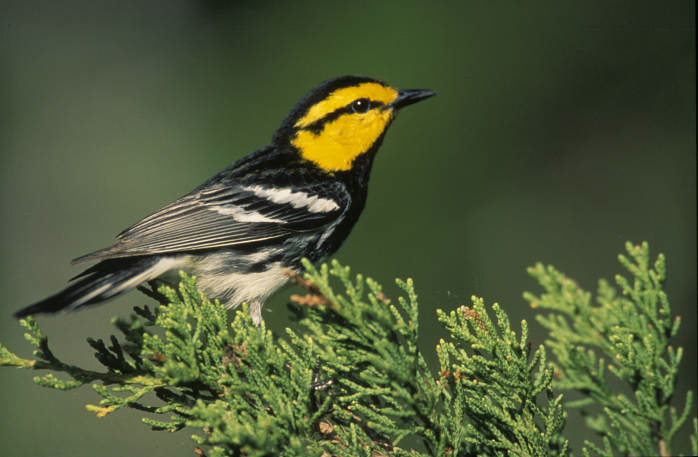
A Golden-cheeked Warbler, one of the rarest warblers in North America, depends entirely on old-growth Ashe juniper at sites like Balcones Canyonlands NWR. Photo: Steve Maslowski/USFWS / CC BY 2.0, view source
Trail 2: East Trail Loop at Lost Maples State Natural Area (Bandera County)
A moderate loop through the Sabinal River canyon at Lost Maples State Natural Area, one of the most geologically and biologically distinctive parks in the Texas State Parks system. The East Trail follows the Sabinal River through a limestone canyon of spring-fed pools, sheer bluffs, and the park's namesake bigtooth maples, a relict population of trees more common in the mountains of northeastern Mexico, isolated here in the Hill Country canyon since the last glacial period. Habitat transitions from riparian sycamore-cypress woodland to cedar-oak upland cover the full range of Hill Country birding. For those wanting more ground, the East Trail connects to the West Trail for a combined ~10-mile full-day loop.
Lost Maples is an unexpected place. The park sits in a remote canyon of the Sabinal River, two hours from San Antonio on a road that goes nowhere in particular, and its bigtooth maple trees are genuinely strange: a cold-adapted species that has no business surviving in Central Texas, marooned in this canyon since the last ice age when a cooler, wetter climate extended far south of its current range. Most people come in October for fall color. Birders know the park in spring and early summer for what the canyon holds year-round: Golden-cheeked Warblers in the cedar-oak uplands, Black-capped Vireos in the low scrub, a healthy resident population of Canyon Wrens ringing off the limestone walls, and Zone-tailed Hawks cruising the thermals overhead, a species that mimics the silhouette of the much more common Turkey Vulture, flying with dihedral wings among vulture flocks to approach prey undetected.
The Lost Maples eBird hotspot carries a cumulative park checklist of over 200 species. What distinguishes Lost Maples from Doeskin Ranch is the riparian element: the Sabinal River creates a dense corridor of sycamore, cypress, and willow scrub that draws a different guild of birds entirely. Green Kingfishers, tiny dark-green-and-white kingfishers at the northern edge of their Mexican range, work the river pools along the East Trail's creek sections. Yellow-billed Cuckoos call from the riparian canopy from May through August. The park is also one of the more reliable Texas Hill Country sites for Varied Bunting, a deep-purple-and-red species found at the very northern limit of its range in the canyon's dry brushy slopes, and for rare but documented Colima Warbler sightings on the upper trail switchbacks connecting to the West Trail, one of the very few U.S. sites outside Big Bend where the species has appeared.
🦜 Species to Watch For at Lost Maples State Natural Area
💡 Pro Tip: Lost Maples is a significant drive from any major city, so arrive the evening before if you can, staying in Vanderpool or nearby Utopia. The park requires advance day-use reservations through the TPWD online system during fall color season (late October to mid-November) and on busy spring weekends; book ahead year-round to be safe. Walk the East Trail early and spend time on the canyon overlook sections for Zone-tailed Hawk and Golden-cheeked Warbler. For Green Kingfisher, focus on the Sabinal River crossing sections at mid-morning, scanning the river pools from the trail above. The Lost Maples eBird hotspot has real-time reports; filter for April and May for the full spring picture before you go.
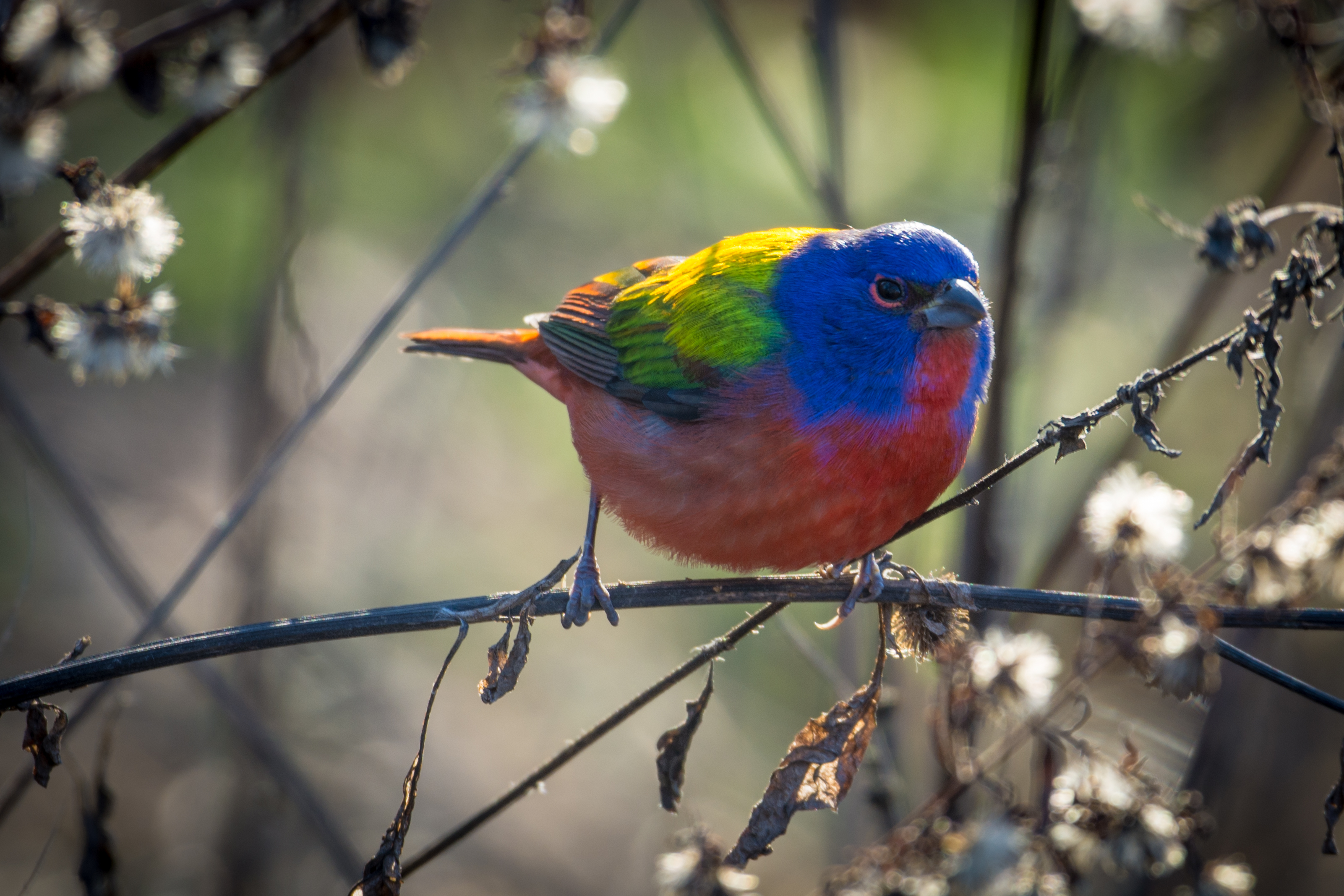
Male Painted Bunting, called by Audubon the "Nonpareil" (meaning without equal). Males are vivid blue, green, and red; females are bright lime green. A summer resident at all three sites in this guide. Photo: Andrew Cannizzaro / CC BY 2.0, view source
Trail 3: Pedernales Loop via Trammel Crossing at Pedernales Falls State Park (Blanco County)
A 5.7-mile loop through the most accessible of the three sites in this guide, combining the Pedernales River's limestone ledge waterfalls, juniper-oak uplands, and the Trammel Crossing creek corridor, a stepping-stone river crossing through riparian sycamore and cottonwood. The loop covers more habitat variety than either of the other two sites: open river, riparian scrub, limestone cliff, and classic Hill Country juniper woodland, all in a single route less than an hour's drive from Austin's western suburbs.
Pedernales Falls State Park is the most straightforward entry point in this guide, well-signed at 45 miles from Austin with solid trail infrastructure, and for that reason it's often the first Hill Country birding stop for visitors from the city. The falls themselves are a series of stair-step limestone ledge waterfalls on the Pedernales River, and the river corridor threads through the entire loop. Green Kingfishers work the pools below the falls; Canyon Wrens ring from the limestone ledges year-round with their cascading, descending song, one of the most distinctive vocalizations in North American birding; Painted Buntings are conspicuous in the riparian scrub from May through August.
The park's Pedernales Falls eBird hotspot has documented 150+ species. What makes Pedernales Falls worth the drive specifically for birding, rather than just for scenery, is the consistent Golden-cheeked Warbler habitat in the juniper-live oak woodland above the river. The Trammel Crossing section of the loop passes through exactly the kind of mature cedar-oak mix where the species is most reliably found. Spring mornings can produce an impressive warbler layering effect: Nashville Warblers, Orange-crowned Warblers, and Yellow-rumped Warblers move through in migration alongside the resident Golden-cheeks, creating active mixed flocks that are easy to pick through for the signature black-and-gold pattern.
The Trammel Crossing itself is the river crossing section: stepping stones across the Pedernales that are passable most of the year but can be impassable after significant rainfall. Vermilion Flycatchers, males a shocking fire-engine red and one of the most visually arresting birds in North America, hunt from low perches along the creek margins throughout the spring and summer. Scissor-tailed Flycatchers are conspicuous on the open upland sections, perching on fence posts and wire in between aerial sallies that show off their extraordinary elongated tail streamers, sometimes exceeding the bird's body length. The Golden-fronted Woodpecker, a Hill Country resident with a golden nape and red crown patch, drums from the larger trees throughout the loop year-round.
🦜 Species to Watch For at Pedernales Falls State Park
💡 Pro Tip: The falls viewpoint is heavily visited by non-birders in summer; arrive before 8 am to have the trail largely to yourself and to catch peak bird activity. The Trammel Crossing section (the second half of the loop, after the falls) is consistently more productive for Golden-cheeked Warblers than the heavily-trafficked falls area. Entry requires a TPWD fee or State Parks Pass. The Trammel Crossing may be flooded after significant rain, so check conditions before driving out; the park posts river levels on its website. Recent checklists on the Pedernales Falls eBird hotspot give a real-time picture of what's active.
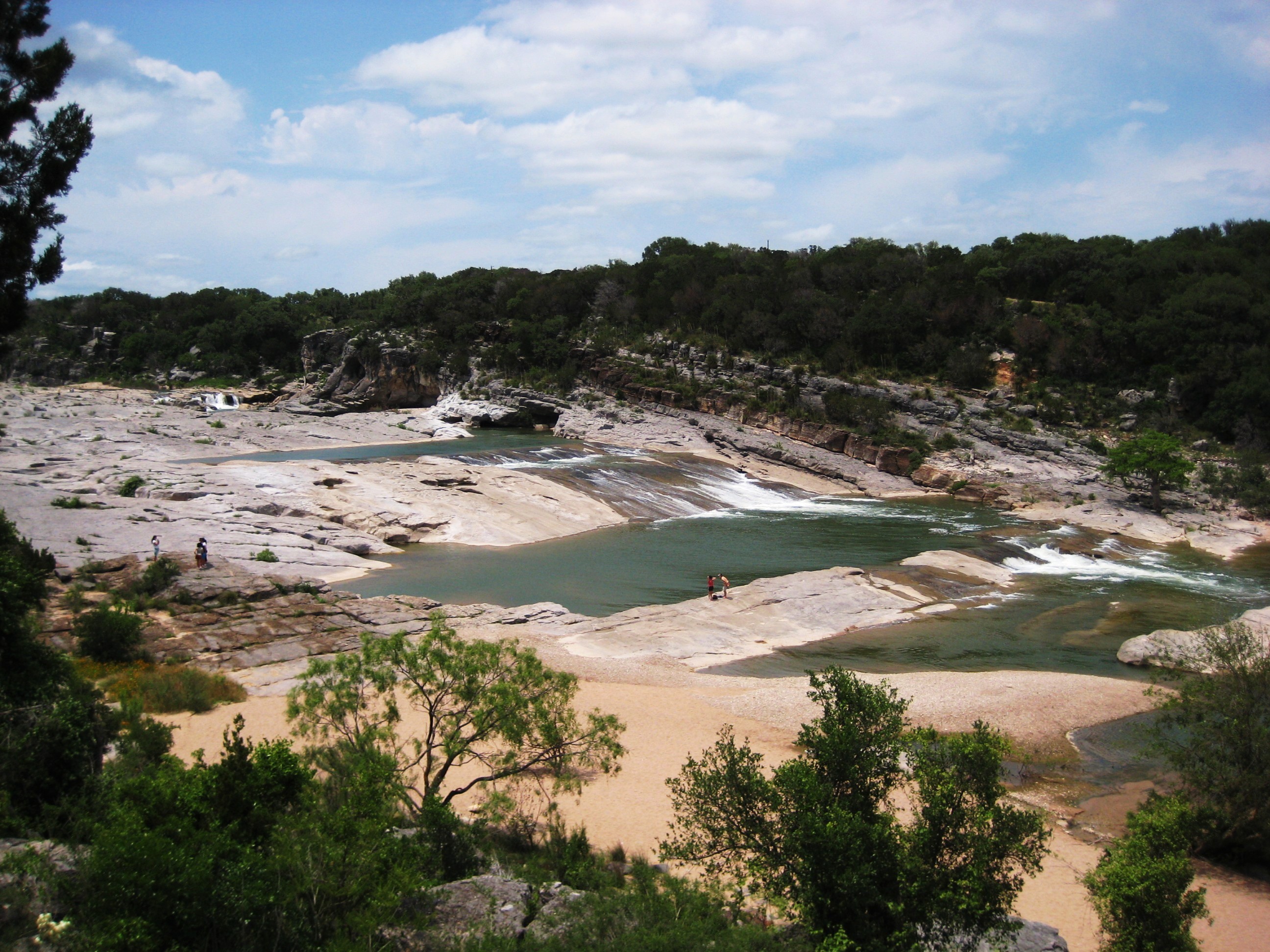
The limestone ledge waterfalls of the Pedernales River, the defining landscape feature of Pedernales Falls State Park. Canyon Wrens ring from these bluffs year-round; Green Kingfishers work the pools below the falls. Photo: Travis Witt / CC BY-SA 3.0, view source
Best Times to Bird the Texas Hill Country: A Seasonal Guide
The Hill Country offers distinct birding character in every season, though the spring window is the primary draw for visiting birders. The Golden-cheeked Warbler's breeding season (late February through early July) defines the calendar, but summer, fall, and winter each have their own specific value.
🌸 Spring (March–May)
Peak season for the Hill Country's signature species. Golden-cheeked Warblers arrive from late February and are singing actively through mid-May; the window from late March through late April is the sweet spot for song activity and territory behavior. Black-capped Vireos arrive in April; Painted Buntings appear in April and are conspicuous through June. Migrant warblers layer over the resident species in April and May: Nashville, Yellow-rumped, Wilson's, and Orange-crowned all pass through. Scissor-tailed Flycatchers return to open country in March. Arrive early: 7–9 am on a still morning is the optimal window at all three sites.
☀️ Summer (June–August)
Breeding season for Hill Country residents. Golden-cheeked Warblers remain on territory through late June; most have departed by August. Painted Buntings are conspicuous and singing into August; males are easiest to find near water in summer heat. Yellow-billed Cuckoos call from riparian corridors at Lost Maples and Pedernales through mid-August. Vermilion Flycatchers are year-round residents and active breeders along creek corridors. Summer heat in Central Texas is significant; early mornings (before 9 am) are essential for both bird activity and comfort.
🍂 Fall (September–November)
Migration brings a different cast through the Hill Country's juniper-oak corridor. Ruby-throated Hummingbirds peak at feeders in September before moving south. Creek corridors at Lost Maples and Pedernales attract fall warblers and Empidonax flycatchers in September and October. Sparrow diversity increases in October and November as winter residents arrive; look for Lincoln's, Fox, and Vesper Sparrows at brushy edges at all three sites. Lost Maples draws large crowds for fall foliage (late October to mid-November); reserve day-use passes well in advance for this window.
❄️ Winter (December–February)
The Hill Country in winter lacks its summer signature species but offers sparrow diversity and wintering raptors. American Kestrels work the open country at Doeskin Ranch. Golden Eagles occasionally soar above the Rimrock sections. Fox, Lincoln's, Vesper, and Grasshopper Sparrows winter in the brush and grasslands. Canyon Wrens, Golden-fronted Woodpeckers, and Carolina Chickadees are year-round and conspicuous. Late February brings the first returning Golden-cheeked Warblers; the season's earliest individuals are occasionally reported as early as February 20th at Doeskin Ranch.
FAQ: Texas Hill Country Birding
Is the Golden-cheeked Warbler really found only in Texas?
Yes, it is the only bird species in the United States whose entire global breeding range lies within a single state. The species breeds exclusively in 33 counties of the Edwards Plateau in Central Texas, arriving from wintering grounds in Mexico and Central America in late February and departing by July or early August. It was listed under the Endangered Species Act in 1990. Balcones Canyonlands NWR was established two years later specifically to protect breeding habitat for this species and the Black-capped Vireo. Current population estimates range from 9,000 to 14,000 breeding pairs; continued urban development encroaching on Ashe juniper-oak woodland in the Austin-San Antonio corridor remains the primary threat.
When is the best time to see a Golden-cheeked Warbler?
Late March through May is the optimal window. Males arrive from the south in late February and early March and begin singing immediately on territory. Song activity is highest in March through late April; by late May, pairs are feeding nestlings and are less vocal but still present in the area. By mid-July, most have departed for the winter. The best time of day is the first two hours after sunrise, on calm mornings with no wind. The Shin Oak Observation Deck at Doeskin Ranch is the most reliable single viewing location in the Hill Country.
What makes the Texas Hill Country different from the Gulf Coast for birding?
The Hill Country and the Texas Gulf Coast are entirely different experiences. The Gulf Coast, particularly High Island and Bolivar Peninsula, is famous for spring migration fallouts: neotropical migrants crossing the Gulf of Mexico and making landfall en masse after exhausting over-water flights. The Hill Country is about breeding specialties: species that live in this specific landscape year after year. The Golden-cheeked Warbler, Black-capped Vireo, and Canyon Wren are not spectacle birds that appear by the tens of thousands; they're residents of specific habitats at specific sites. A Hill Country trip in April can feel quieter than High Island in the same week, but it delivers encounters with birds you genuinely cannot find anywhere else on Earth during breeding season.
Do I need to visit all three sites in one trip?
Doeskin Ranch (Balcones Canyonlands NWR) and Pedernales Falls State Park can be combined in a single long day from Austin; they're 45 miles apart and both accessible from US-290. Lost Maples is a longer drive (85 miles west of San Antonio) and works better as an overnight trip. For a single focused visit, Doeskin Ranch is the top priority: it's the closest to Austin, has the highest eBird species total of the three sites, and was purpose-built for exactly the birds the Hill Country is most known for.
Are permits or reservations required?
Balcones Canyonlands NWR's Doeskin Ranch unit is free and requires no permit or reservation, open during daylight hours. Lost Maples State Natural Area requires advance day-use reservations through the TPWD online system during fall foliage season (October–November) and on busy spring weekends; booking ahead year-round is wise. Pedernales Falls State Park charges a standard TPWD day-use entry fee (Texas State Parks Pass holders enter free). None of the three sites require a special birding permit.
More Trail Guides
- Pacific Northwest Birding: Hoh Rain Forest, Hurricane Ridge & Mount Rainier
- San Francisco Bay Area Birding: Golden Gate Park, Point Reyes & Don Edwards NWR
- Michigan Lower Peninsula Birding: Tawas Point, Sleeping Bear Dunes & the Kirtland's Warbler
Get the Next Guide in Your Inbox
New regions drop every few weeks. Subscribe and never miss a trail guide.
Subscribe Free →📷 Photo Credits
Hero image of Male Golden-cheeked Warbler (Setophaga chrysoparia), Balcones Canyonlands NWR: USFWS / Southeast Region / CC BY 2.0. Via USFWS Southeast Flickr.
Painted Bunting (Passerina ciris), male: Andrew Cannizzaro / CC BY 2.0. Via Wikimedia Commons.
Pedernales Falls State Park limestone ledges: Travis Witt / CC BY-SA 3.0. Via Wikimedia Commons.