There's a morning I keep thinking about at Point Reyes. I was an hour into the Bear Valley Trail, deep in Douglas fir and bay laurel and still dark enough under the canopy that I was mostly listening, when a Varied Thrush started singing somewhere off the trail to the left. Not the song itself that got me, but what happened after: complete silence from everything else, like the whole forest went still to listen. Five minutes of that. Then a Pacific Wren picked up somewhere behind me, and then it was just birds again.
The San Francisco Bay Area is one of those rare places where every major type of birding is world-class within an hour's drive of the city. The Pacific Flyway runs directly up the coast. San Francisco Bay, the largest Pacific estuary in the Americas, holds millions of shorebirds and waterfowl each winter. And Point Reyes, jutting 10 miles into the Pacific, has been named the #1 birding destination in the United States by the National Audubon Society, with 490 species recorded. This guide covers three trails that capture that range (one in the city, one in the coastal forest, one in the salt marsh) and how to time each one.
Why the SF Bay Area Is One of North America's Best Birding Regions
The Pacific Flyway is the westernmost of North America's four major migration corridors, funneling birds from Alaska and the Yukon south to Central and South America along the Pacific Coast. The Bay Area sits squarely at the intersection of two geographic forcing functions: the coastline, which concentrates migrants moving south, and San Francisco Bay, a 1,600-square-mile estuary whose tidal mudflats and seasonal wetlands provide critical stopover habitat for shorebirds that have been flying since Alaska.
Point Reyes amplifies this further. The peninsula's position jutting west into the Pacific means it intercepts birds that would otherwise blow past the Bay. Its combination of habitats (coastal scrub, Douglas fir forest, freshwater lagoons, marine bluffs, salt marsh, and open grassland) produces a species list that 54% of all North American bird species have contributed to at some point. Point Reyes on eBird is one of the most-checked hotspots in the western United States, and the fall vagrant season draws birders from across the country searching for Asian and Mexican strays that turn up nowhere else on the continent.
The Bay itself matters year-round. Don Edwards San Francisco Bay National Wildlife Refuge, the first and largest urban national wildlife refuge in the United States, protects 30,000 acres of tidal marsh, salt pond, and mudflat in the South Bay. The numbers it produces for shorebirds are staggering: during fall and winter, the mudflats hold tens of thousands of Dunlin, Western Sandpipers, and Least Sandpipers alongside Marbled Godwits, Long-billed Curlews, and American Avocets in their rusty breeding finery.
For shorebird-focused trips on the Atlantic side, compare our NYC birding trails guide. For old-growth rainforest and alpine birding also on the Pacific Flyway, see our Pacific Northwest birding guide.
Trail 1: Blue Heron Lake & Strawberry Hill Loop at Golden Gate Park (San Francisco)
A paved loop circling Blue Heron Lake and the forested Strawberry Hill island, with a short climb to the island summit if you cross either of the two stone bridges. The San Francisco Botanical Garden (Arboretum) is immediately adjacent to the west, and the combination of the lake, the island forest, and the botanical garden's 55 acres of diverse plantings creates one of the most productive urban birding corridors in California. Fully accessible except the optional Strawberry Hill summit path.
Golden Gate Park was not always thought of as a birding destination. Then birders started paying attention to the San Francisco Botanical Garden, which sits directly adjacent to Blue Heron Lake, and numbers started coming out that made people take notice. On a fall morning with a weather system pushing migrants down, an experienced observer can pull 50+ species from the Garden's 55 acres alone, including rarities that have no business being in an urban park. The Garden's diversity of plantings (8,000+ species from five global climate zones) gives cover and food to an extraordinary range of vagrant birds, particularly in October and November.
The Golden Gate Park Arboretum eBird hotspot has accumulated over 200 species, with key micro-habitats including the Moon Viewing Garden (good for deciduous-tree warblers and flycatchers), the Muir Pond willow thicket (vagrant trap for skulking species), and the Succulent Garden (best spot in the park for hummingbirds). The lake loop itself adds the waterbirds: Common Mergansers, Pied-billed Grebes, and an improbable colony of Ring-necked Ducks that overwinter on the lake most years.
Golden Gate Park was renamed the lake from Stow Lake to Blue Heron Lake in January 2024, partly as a land acknowledgment and partly in honor of the Great Blue Herons that nest in the eucalyptus canopy along the lake's north shore each spring, in full view of the path. The nesting colony is active January through June, with adults coming and going from the lake to feed, and juveniles visible from the shoreline trail by April.
🦜 Species to Watch For at Golden Gate Park
💡 Pro Tip: The Botanical Garden and the lake work best as a combined morning: enter the Garden at the main gate on Martin Luther King Jr. Drive at 9th Avenue when it opens (7:30 a.m. most days; free for SF residents, small fee for others). Work the Moon Viewing Garden and Muir Pond slowly, then exit through the east gate and pick up the lake loop clockwise to see the heron nesting trees on the north shore. In fall, check the Garden's rare bird reports on the Golden Gate Bird Alliance website before you go; when something unusual shows up, locals post immediately.
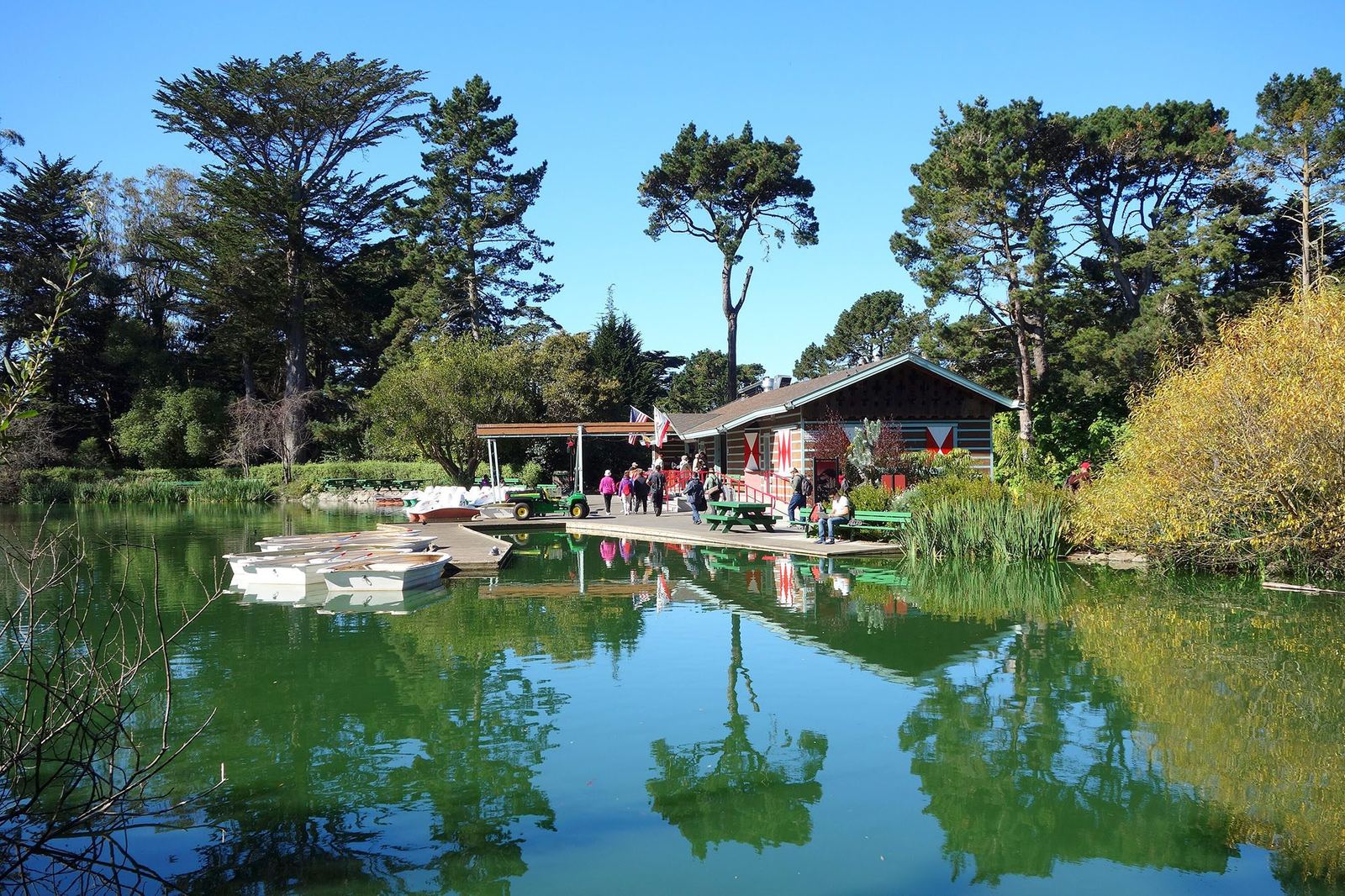
Blue Heron Lake in Golden Gate Park, renamed in 2024 to honor the Great Blue Herons that nest along its shores each spring. The adjacent San Francisco Botanical Garden is one of the top vagrant traps on the West Coast during fall migration. Photo: Daderot / CC0 1.0 via Wikimedia Commons, view source
Trail 2: Bear Valley Trail to Arch Rock at Point Reyes National Seashore (Marin County)
A wide, well-maintained trail running 4.5 miles from the Bear Valley Visitor Center through Douglas fir and bay laurel forest, across Divide Meadow, and down to the bluffs above Drakes Bay at Arch Rock, a natural rock arch at the trail's terminus with views north and south along the Point Reyes coast. The forest section is where the birding is best; the meadow and coastal bluff add raptors and open-country species. A shorter 3.4-mile out-and-back to Divide Meadow omits the coast but includes the best forest birding.
Point Reyes is the kind of place that birders come back to for decades without running out of new things to find. The Point Reyes eBird hotspot region holds 490 recorded species, roughly 54% of all bird species found in North America. The National Audubon Society has named it the #1 birding destination in the United States multiple times. Bear Valley is where most of that land-bird diversity lives: the riparian corridor along Bear Valley Creek and the dense Douglas fir forest on either side of the trail create one of the most productive hiking birding experiences on the Pacific Coast.
The trail rewards slow walking. The forest section in the first 2 miles is where Pacific Wrens, Chestnut-backed Chickadees, and Wilson's Warblers move through the undergrowth, often in mixed flocks that appear suddenly and vanish into the brush. Varied Thrushes, perhaps the most hauntingly beautiful bird in the Pacific coastal forests with their eerie ringing song, are common here in winter and early spring, moving through the understory in small groups. Pileated Woodpeckers are resident in the mature forest; listen for the reverberating drum or watch the high canopy for the red-crested silhouette.
Divide Meadow, at 3.4 miles, is a clearing surrounded by coastal scrub where the open-country species appear: White-tailed Kite, Northern Harrier, California Quail calling from the brush edges, and in winter a Peregrine Falcon hunting the meadow edges. Most birders linger here before deciding whether to continue to the coast; the meadow is productive enough to justify the 3.4-mile walk on its own.
At the coast, the rocky marine habitat below Arch Rock adds yet another dimension: Black Oystercatchers on the sea stacks, Brandt's Cormorants and Pigeon Guillemots on the offshore rocks, and in late spring the distant silhouettes of Tufted Puffins from the offshore colonies visible with a spotting scope.
🦜 Species to Watch For at Point Reyes / Bear Valley
💡 Pro Tip: The Bear Valley Visitor Center itself has a small bird feeding station and a riparian corridor behind the center that can be excellent for warblers and sparrows; don't skip it while grabbing your trail map. For the forest section, early morning in winter (December–February) is the best time for Varied Thrushes: they're most vocal in the hour after first light. The Point Reyes eBird hotspot is updated constantly by a passionate local community; check it before any visit to see what's active. The Spotted Owl has been confirmed on the property historically; it's never "expected," but it has been found along the trail by observers who went looking quietly at dusk.
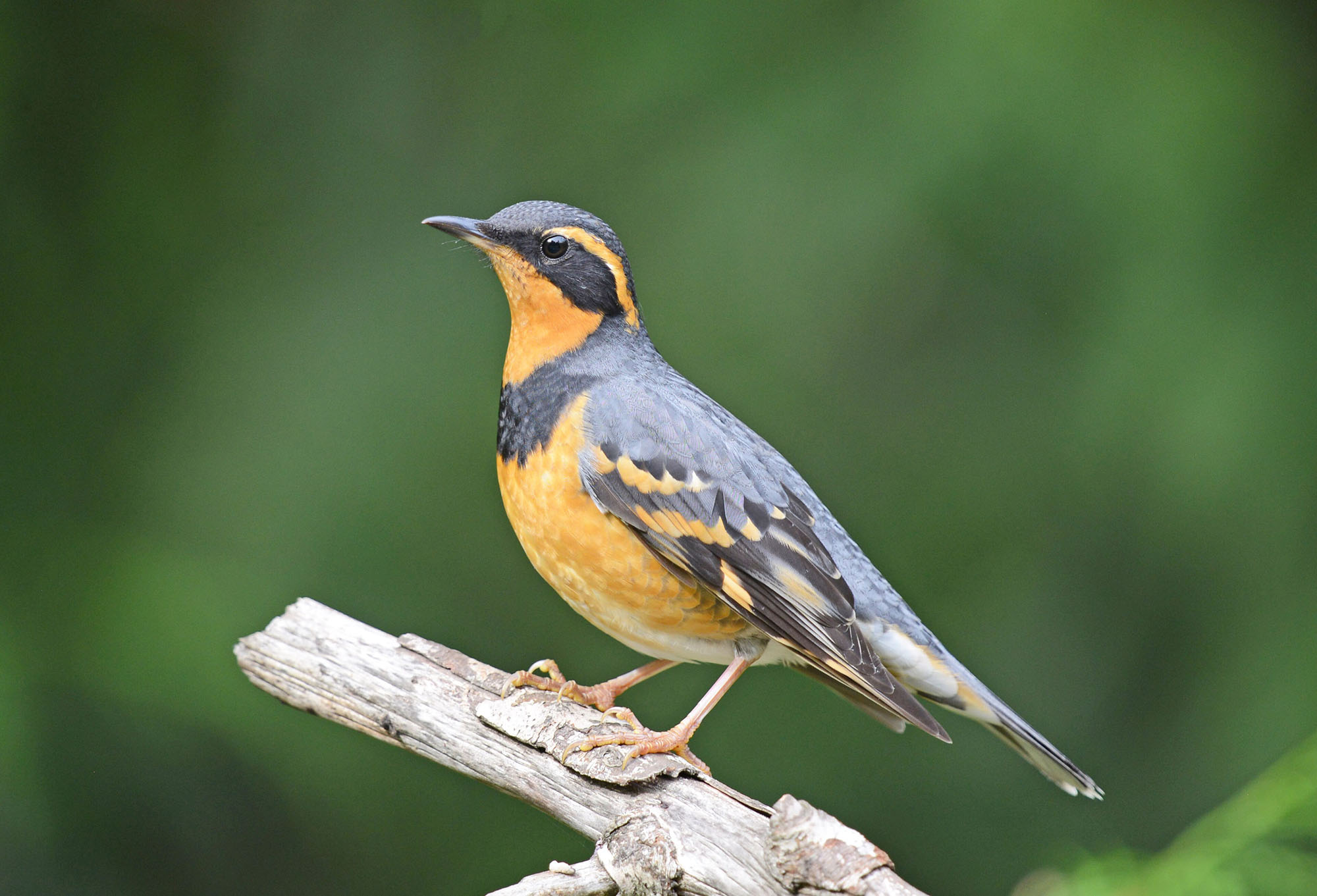
Varied Thrush, the forest signature bird at Point Reyes in winter. Its single, sustained tone echoes through the Douglas fir canopy along Bear Valley Trail from November through March. Photo: Vickie J Anderson / CC BY-SA 4.0 via Wikimedia Commons, view source
Trail 3: Newark Slough Trail at Don Edwards SF Bay National Wildlife Refuge (Fremont)
A flat, mostly unpaved loop along the levee trails of Newark Slough, a tidal channel cutting through the restored salt marsh and managed salt ponds of Don Edwards National Wildlife Refuge. The trail crosses an iconic footbridge over the slough midway through the loop, with open-water views in both directions. The surrounding salt ponds and mud flats attract the highest concentrations of shorebirds, waterfowl, and wading birds in the Bay Area. The levee paths are exposed and shadeless; bring sun protection and water year-round.
Don Edwards San Francisco Bay National Wildlife Refuge was established in 1972 as the first urban national wildlife refuge in the United States. It now protects 30,000 acres of tidal marsh, salt pond, and seasonal wetland in the South Bay, a fraction of the 190,000 acres of wetland that existed here before the Bay was diked and drained for agriculture and salt production in the 19th and early 20th centuries. The ongoing restoration of former industrial salt ponds back to tidal marsh is one of the largest wetland restoration efforts in the world, and the birds are already responding.
What makes the Newark Slough Trail exceptional is the concentration of shorebirds during migration. The managed salt ponds adjacent to the trail hold water levels calibrated to expose optimal mudflat depths for feeding birds, which means that on a good fall morning in September or October, the ponds can hold Western Sandpipers and Dunlin in the tens of thousands, a density that turns the whole horizon into moving dots. American Avocets, elegant long-legged waders with the rusty-orange necks of breeding plumage, are present from spring through fall in flocks of dozens to hundreds. Black-necked Stilts breed in the refuge, their sharp calls cutting across the flat landscape from March through August.
The Long-billed Curlew (the largest shorebird in North America, with a bill so curved it looks structurally impossible) winters here in reliable numbers. Marbled Godwits and Whimbrels feed along the slough banks. In winter, the open water fills with diving ducks: Canvasbacks, Buffleheads, Ruddy Ducks, and occasionally Greater Scaup in large rafts. Peregrine Falcons are year-round residents; look for them on the transmission towers and power poles along the levee, from which they launch into the shorebird flocks in spectacular stoops.
🦜 Species to Watch For at Don Edwards NWR
💡 Pro Tip: Tide timing matters more at Don Edwards than almost any Bay Area birding site. When the tide is high, shorebirds are pushed off the mudflats and concentrate on the levee edges and salt pond margins, which is actually great for viewing, as birds crowd close to the trail. At low tide, they spread across the exposed flats and can be distant. Aim for a mid-morning visit 1–2 hours after high tide, when birds are redistributing. The refuge website posts tide charts; cross-reference with the South Bay eBird hotspots to find which ponds are most active before you go. The Environmental Education Center at the trailhead is also worth a stop: staff often know what's been reported that morning.
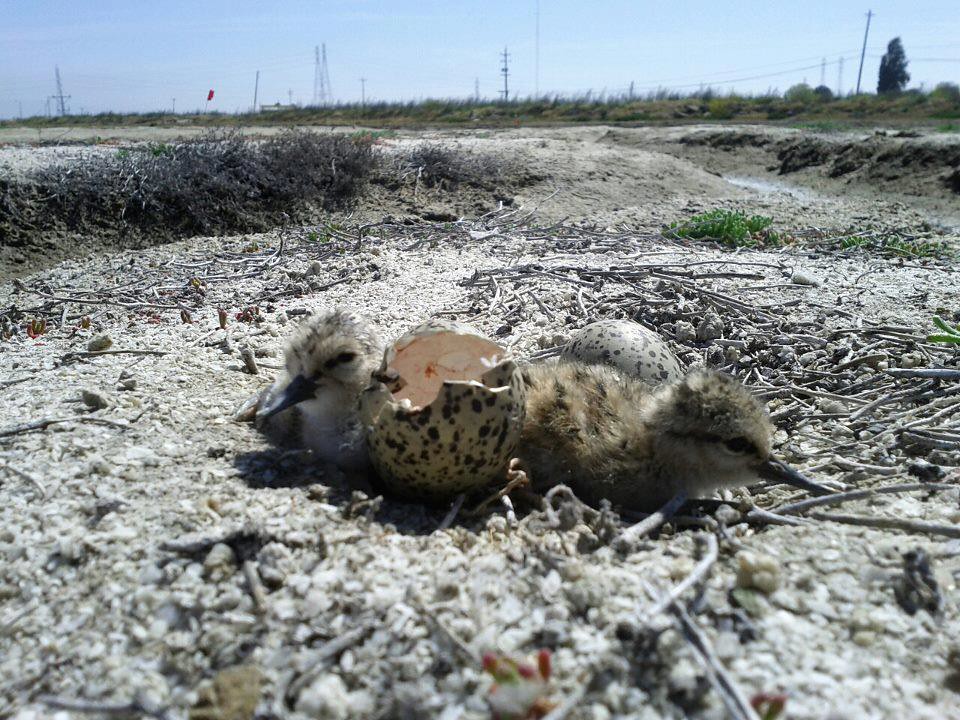
American Avocet chicks at Don Edwards SF Bay NWR, where salt ponds and managed wetlands provide critical habitat for nesting shorebirds. Photo: Bryan White/USFWS Pacific SW / CC BY 2.0, view source
Best Times to Bird the SF Bay Area: A Seasonal Guide
The Bay Area has genuinely good birding in every month of the year, which is one of its unusual strengths compared to most North American birding regions. The combination of a mild, consistent climate with Pacific Flyway migration creates overlapping seasons rather than distinct peaks.
🌸 Spring (February–May)
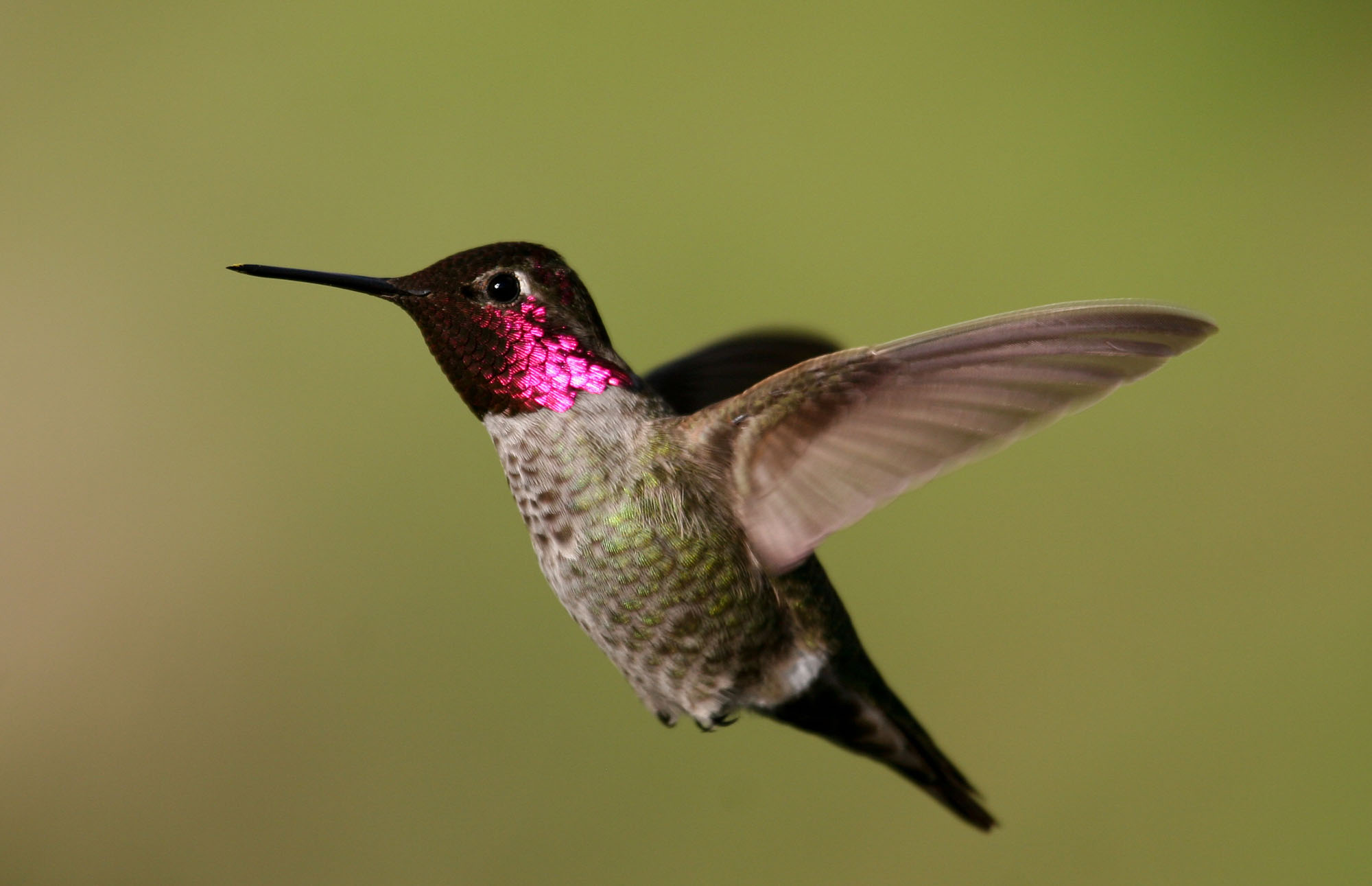
Allen's Hummingbirds arrive in Golden Gate Park and the coastal hills as early as mid-January, and males are displaying by February. Spring warbler migration peaks at Point Reyes and GGP in April–May: Orange-crowned and Wilson's Warblers move through in good numbers. Don Edwards fills with breeding American Avocets and Black-necked Stilts; shorebirds moving north concentrate on the salt ponds in April and May. Tufted Puffins appear offshore at Point Reyes from April.
☀️ Summer (June–August)
Breeding birds are active at all three sites. Allen's Hummingbirds are on territory in GGP through July. Point Reyes forest birds nest along Bear Valley Trail: Wilson's Warblers and Pacific-slope Flycatchers are vocal through early July. The southbound shorebird migration begins earlier than most people expect: first southbound Western Sandpipers appear at Don Edwards in late June, with numbers building through July and August. American White Pelicans congregate on the salt ponds from July onward.
🍂 Fall (September–November)
The peak season for two of the three sites. Shorebird numbers at Don Edwards peak in September–October with Western Sandpiper and Dunlin counts in the tens of thousands on good days. The SF Botanical Garden is at its best for vagrants in October: the combination of cool nights, light fog, and diverse plantings pulls in species that have no business being in San Francisco. Point Reyes fall vagrant season is legendary: Asian and Mexican strays appear regularly from September through November.
🌧️ Winter (December–January)
Varied Thrushes arrive at Point Reyes in November and remain through March: their ringing, single-note song defines the Bear Valley forest in December and January. Don Edwards hosts its largest waterfowl concentrations: Canvasbacks, Buffleheads, Ruddy Ducks, and Scaup pack the salt ponds. Anna's Hummingbirds, the only hummingbird that overwinters in the Bay Area, are conspicuous and territorial throughout Golden Gate Park. Check for Snowy Owls in irruption years along the South Bay levees.
FAQ: San Francisco Bay Area Birding
When is the best time to visit the Bay Area for birding?
The Bay Area has year-round excellent birding, but two windows stand out: late April through early May for spring songbird migration at Point Reyes and Golden Gate Park, and September through October for peak shorebird numbers at Don Edwards plus fall vagrant season in the SF Botanical Garden. If you can only visit once, October combines all three sites performing at or near their best: shorebirds at Don Edwards, fall migrants and rarities at GGP, and the beginning of the winter thrush season at Point Reyes.
Is Point Reyes birding accessible for beginners?
Yes: the Bear Valley Trail is well-maintained, clearly signed, and gentle enough that beginners who aren't fit birders can enjoy the first 2–3 miles to Divide Meadow without difficulty. The forest birds along Bear Valley Creek reward slow walking rather than experience: Chestnut-backed Chickadees, Steller's Jays, and Wilson's Warblers are common and cooperative. The Bear Valley Visitor Center has free trail maps and staff who know what's been seen recently. The Point Reyes eBird hotspot bar charts are an excellent tool for beginners; they show exactly which species are most likely in any given week of the year.
Can I do SF Bay Area birding without a car?
Golden Gate Park is fully reachable by Muni from anywhere in San Francisco: take the 5, 5R, or 21 bus to the park's eastern end, or the N-Judah streetcar to 9th and Irving. Don Edwards NWR is accessible via BART to Fremont Station, followed by a 2-mile bike ride or rideshare to the trailhead; rideshares are reliable and quick from Fremont Station. Point Reyes is the hardest: the West Marin Stagecoach (Route 68) runs from San Rafael SMART train station to Point Reyes Station on weekends and some weekdays, and the Bear Valley Visitor Center is a short walk or rideshare from the town center.
What is the Pacific Flyway and how does it affect Bay Area birding?
The Pacific Flyway is the westernmost of North America's four major bird migration corridors, running from Alaska and northern Canada south along the Pacific Coast to Central and South America. The Bay Area sits at a critical bottleneck: San Francisco Bay's mudflats and salt marshes provide essential refueling habitat for shorebirds that may have flown from Alaska to California in a single 3–4 day flight, arriving depleted and needing to double their body weight before continuing south. Point Reyes's position jutting into the Pacific also intercepts vagrant birds blown off course (Asian species from across the Pacific and Mexican species pushing north), making it one of the most watched patches for rare bird records in the western hemisphere.
More Trail Guides
- Chicago & North Shore Birding: Montrose Point, Skokie Lagoons & Illinois Beach on the Mississippi Flyway
- Pacific Northwest Birding: Hoh Rain Forest, Hurricane Ridge & Mount Rainier
- Michigan Lower Peninsula Birding: Tawas Point, Sleeping Bear Dunes & the Kirtland's Warbler
Get the Next Guide in Your Inbox
New regions drop every few weeks. Subscribe and never miss a trail guide.
Subscribe Free →📷 Photo Credits
Hero image of Male Anna's Hummingbird (Calypte anna): Alan D. Wilson / CC BY-SA 3.0. Via Wikimedia Commons.
Blue Heron Lake, Golden Gate Park: Daderot / CC0 1.0 Public Domain. Via Wikimedia Commons.
Varied Thrush (Ixoreus naevius): Vickie J Anderson / CC BY-SA 4.0. Via Wikimedia Commons.