Every May, something remarkable happens along Chicago's lakefront. Birds that have been flying north for weeks, across the Gulf of Mexico, through Arkansas and Tennessee, up through Missouri, run headlong into Lake Michigan. There's nowhere to go but down. They pile into every scrap of woodland and shrubby cover on the shore: hundreds of species, thousands of individuals, concentrated into small urban greenspaces at densities you'd never see anywhere inland. A single morning walk at Montrose Point in peak migration can deliver 30 species of warblers before breakfast.
Chicago is one of the best urban birding cities in North America, and it's underrated specifically because most people don't expect it. The city sits squarely on the Mississippi Flyway, and Lake Michigan acts as a giant funnel, forcing migrating birds to stop and refuel. This guide covers three trails that make the most of that geography: one inside the city limits, one on the suburban North Shore, and one 50 miles north on a Lake Michigan shoreline where the birding gets wilder.
Why Chicago Is a World-Class Birding City
The Mississippi Flyway is the busiest bird migration corridor in North America, moving hundreds of millions of birds between the boreal forests of Canada and the tropics each spring and fall. Chicago sits at its eastern edge, right where it meets Lake Michigan. That lake, 307 miles long and cold enough to stop migration dead in its tracks, creates the geographic pressure that makes lakefront birding here so extraordinary.
Montrose Point is ranked #1 in all of Illinois on eBird with 349 recorded species. On a good morning in the second week of May, birders will check off 20–25 warbler species without leaving a 15-acre sanctuary. The famous "Magic Hedge", a 150-yard stretch of honeysuckle and shrubs that once hid a Cold War missile installation, is consistently one of the most productive small birding spots in the United States.
Beyond the city, the North Shore adds wooded lakeside corridors, a chain of interconnected lagoons where virtually every regional warbler species passes through each spring, and a state park at the Wisconsin border with 300+ species and shorebird habitat unlike anything else in Illinois.
For migration spectacle in a dense urban setting, compare our NYC birding trails guide. For old-growth rainforest and alpine birding on the Pacific Flyway, see our Pacific Northwest birding guide.
Trail 1: Montrose Point Bird Sanctuary Trail (Chicago)
A paved and crushed-stone loop through the 15-acre sanctuary, circling the Magic Hedge, the Tangle, the Magic Clump, and the open lakefront. An accessible ADA 1/3-mile loop connects the key birding areas. The sanctuary juts into Lake Michigan on fill land, creating a natural migrant trap on three sides of water. Best entered at the Montrose Harbor lot.
Montrose Point is not a large place: 15 acres, about the size of a few city blocks. What makes it extraordinary is its position: a small wooded peninsula projecting into Lake Michigan, surrounded by water on three sides, with the only trees and shrubs for miles in the right direction. Birds making landfall after crossing the lake from the south or dropping down after northerly winds grounded them overnight have no better option than to land here.
The Montrose Point eBird hotspot has accumulated 349 species, the highest total of any location in Illinois. On peak mornings in the second week of May, it's common to log 25–30 warbler species in a single visit. The Magic Hedge is the center of gravity: a dense honeysuckle thicket where birds feed, rest, and become briefly visible at close range. Show up at dawn, walk slowly, and look into the hedge from the perimeter path.
The Chicago Park District added an accessible 1/3-mile loop in 2021 that links the Magic Hedge, Magic Clump, and the Tangle, a secondary shrubby area on the north end of the sanctuary, making this one of the most accessible major birding sites in the Midwest. Even outside peak migration, the Black-crowned Night-Heron colony at the nearby Lincoln Park Zoo is worth a short detour: dozens of herons nest in trees along the zoo's north perimeter, visible from the public path.
🦜 Species to Watch For at Montrose Point
💡 Pro Tip: The single best variable for Montrose Point is wind direction the night before. A clear night with southerly winds moves birds north; a cold front from the north stops them. Check the Montrose Point eBird bar charts to see exactly which warblers peak in which week; the frequency graphs are remarkably precise. Arrive before sunrise, walk the perimeter of the Magic Hedge counterclockwise, then check the Tangle and the lakefront point. Bird activity is largely over by 9–10 a.m.

The Magic Hedge at Montrose Point Bird Sanctuary, a 150-yard thicket of honeysuckle and shrubs that once concealed Cold War-era military barracks. Today it's the most-birded spot in Illinois, drawing hundreds of warbler species each spring. Photo: via Wikimedia Commons, view source & license
Trail 2: Skokie Lagoons Inner Trail (Winnetka)
A flat forested loop circling the seven interconnected lagoons of the Skokie Forest Preserve, passing through mature oak woodland, willow corridors, and open water edges. The inner trail keeps close to the water's edge, maximizing bird sightings. The Erickson Woods Picnic Grove on the south end is the most-birded section, with island views and Prothonotary Warbler habitat.
The Skokie Lagoons are a 900-acre chain of seven interconnected lakes and channels carved from what was once the Skokie Marsh, running through the North Shore suburbs about 20 miles from downtown Chicago. The Forest Preserve of Cook County manages the property, and what birders care about most is this: in May, virtually every warbler species that migrates through the Chicago region passes through the lagoons. The Chicago Bird Alliance calls it a haven for 20+ warbler species in a single day, along with migrating cuckoos, flycatchers, vireos, and thrushes.
The highlight of the lagoons for serious birders is the Prothonotary Warbler, a golden-headed, blue-winged marsh warbler that breeds in the cavity-laden willows along the water's edge at Erickson Woods. These vivid golden birds are uncommon enough that seeing one is always a highlight; at Skokie, they reliably stay through early June. Look for them in the willows and dead snags at the water's edge on the south side of Erickson Woods.
The 4.2-mile inner loop is relaxed enough that you can bird slowly, stopping to work through mixed flocks in the oak canopy, checking the open water for Wood Ducks and Great Blue Herons, and scanning the willow edges for Prothonotaries. The trail is flat and partially paved, making it one of the more comfortable birding loops on the North Shore.
🦜 Species to Watch For at Skokie Lagoons
💡 Pro Tip: The south end of the lagoons, around the Erickson Woods Picnic Grove (entrance off Willow Rd west of I-94), is the most productive section. Park here, walk the wood-edge paths down to the water, and scan the willow snags for Prothonotary Warblers by 7 a.m. in May and early June. Check the Skokie Lagoons eBird hotspot for recent sightings before you go; the community posts reports daily during peak migration.

Male American Redstart, one of the most reliably seen warblers at both Montrose Point and Skokie Lagoons during May migration. The male fans his tail constantly, flashing orange patches to startle insects from the underbrush. Photo: gailhampshire / CC BY 2.0 via Wikimedia Commons, view source
Trail 3: Dead River & Dunes Loop Trail at Illinois Beach State Park (Zion)
A short loop through black oak savanna and open marsh, ending at an observation platform overlooking the Dead River, a shallow, seasonally disconnected river mouth on Lake Michigan that concentrates shorebirds when water levels cooperate. The narrow sand-and-dirt trail loops through scrub and oak woodland before reaching the river edge. Bring waterproof shoes in spring.
Illinois Beach State Park is the last remaining significant stretch of natural Lake Michigan shoreline in Illinois: 4,160 acres of black oak forest, sand dunes, and rare dune-and-swale habitat that has logged more than 300 species on eBird. Fifty miles north of Chicago, it's worth the drive for what you find there: a birding experience that feels nothing like the manicured urban greenspaces of the city.
The Dead River and Dunes Loop is the park's best short trail for birding. It threads through scrubby oak savanna before reaching the mouth of the Dead River, a shallow, brackish channel that periodically connects to and disconnects from Lake Michigan depending on water level. When the water level is right, the river mouth becomes an exceptional shorebird stop, with Piping Plovers (a federally threatened species that breeds in small numbers here), Solitary Sandpipers, and occasional Red Knots picking along the shoreline.
The lake itself adds an entirely different dimension. In winter, check the open water for rafts of Greater Scaup, diving ducks including Long-tailed Duck and Black Scoter, and Red-throated Loons moving along the shore. The park is also a raptor migration corridor: Broad-winged Hawks pass in September kettles, Bald Eagles are present year-round, and Peregrine Falcons and Merlins are regular fall migrants. The north unit of the park (Illinois Beach State Park North) has a noted fall hawk watch.
🦜 Species to Watch For at Illinois Beach SP
💡 Pro Tip: Illinois Beach is genuinely productive year-round, which makes it different from Montrose and Skokie, which peak strongly in spring. For shorebirds, the key variable is the Dead River's water level; check recent eBird reports for Illinois Beach State Park South in late July through September to see if shorebirds are being reported. For winter waterfowl, walk the beach from the North Unit parking lot northward toward the Wisconsin border; the rafts of diving ducks can be spectacular on calm, cold days.

A Piping Plover on the Lake Michigan shoreline. Illinois Beach State Park hosts one of the few remaining nesting populations of this threatened shorebird on the Illinois coast. Photo: Jim Hudgins/USFWS / Public Domain, view source
Best Times to Bird the Chicago Region: A Seasonal Guide
Chicago's location at the south end of Lake Michigan creates a distinct birding calendar. The lake delays spring slightly compared to inland Illinois, and in fall it acts as a bottleneck, concentrating raptors, shorebirds, and passerines along the shore before they cross or turn south.
🌸 Spring (April–May)
The undisputed peak. Yellow-rumped Warblers arrive mid-April; Baltimore Orioles appear in the last week of April. The main warbler wave hits Montrose Point in the second week of May, with 25–30 species possible in a single morning. Blackpoll Warblers, completing the longest warbler migration on Earth, pass through in the last week of May. Prothonotary Warblers arrive at Skokie Lagoons by early May.
☀️ Summer (June–July)
Migration quiets, but Prothonotary Warblers stay on territory at Skokie Lagoons through late June. The Black-crowned Night-Heron colony near Lincoln Park Zoo is active and visible all summer. Shorebird migration south begins earlier than most people expect: first southbound shorebirds appear at Illinois Beach by mid-July.
🍂 Fall (August–October)
Shorebirds concentrate at the Dead River mouth in August and September when water levels cooperate. Broad-winged Hawk migration peaks at Illinois Beach in mid-September. Fall warbler migration is more spread out than spring but Montrose Point still delivers, especially after cold fronts. Merlin and Peregrine Falcon movement along the lakeshore peaks in October.
❄️ Winter (November–March)
Illinois Beach comes into its own. Greater Scaup, Long-tailed Duck, Black Scoter, and Red-throated Loon are all regular on the lake. Snowy Owls appear in irruption years (check eBird alerts). Bald Eagles congregate at open water leads along the lakeshore. The Lincoln Park Lagoon sometimes holds a Eurasian Wigeon or other rarity.
FAQ: Chicago & North Shore Birding
What is the Magic Hedge at Montrose Point?
The Magic Hedge is a 150-yard stretch of dense honeysuckle and shrubs at Montrose Point Bird Sanctuary in Chicago's Lincoln Park. It occupies land that once screened Cold War-era Nike missile radar installations from public view. After the military departed in the 1970s, local birders noticed the honeysuckle was attracting an unusually high number of migratory birds: the dense cover provides food and shelter for exhausted migrants making landfall on Lake Michigan. Today it's the most frequently birded location in Illinois, with 349 species recorded on eBird. Walk the perimeter path at dawn in May for the best results.
When is the best time to visit Montrose Point Bird Sanctuary?
The second week of May is the statistical peak of spring warbler migration at Montrose Point, based on eBird frequency data. On warm mornings following clear nights with southerly winds, the Magic Hedge and surrounding shrubs can hold dozens of warblers, tanagers, orioles, and thrushes simultaneously. Baltimore Orioles arrive in the last week of April; Blackpoll Warblers, the last major wave, pass through in the final week of May. Arrive before sunrise and plan to spend 2–3 hours. The Montrose Point eBird hotspot bar charts show exactly which species peak in which week.
What warblers can I see at Skokie Lagoons?
Virtually every warbler species that migrates through the Chicago region has been reported at the Skokie Lagoons during spring migration. In a good May morning at Erickson Woods, you might record Yellow, Yellow-rumped, Palm, Nashville, Wilson's, Chestnut-sided, Magnolia, Blackpoll, Black-and-white, American Redstart, Common Yellowthroat, and Northern Waterthrush, among others. The specialty of the lagoons is the Prothonotary Warbler, a golden-headed marsh warbler that breeds in the willow snags at water's edge and can be reliably found through early June.
Is Illinois Beach State Park good for birding year-round?
Yes, more so than most Illinois birding sites. Spring migration brings warblers and shorebirds to the Dead River mouth; summer offers breeding birds and early southbound shorebirds from mid-July. Fall delivers Broad-winged Hawk kettles in September and Peregrine Falcons in October. Winter is genuinely excellent for waterfowl: Greater Scaup, Long-tailed Duck, and occasional Black Scoter are regular on the lake, and Bald Eagles are present all winter. The park has logged 300+ species on eBird across all seasons.
More Trail Guides
- Michigan Lower Peninsula Birding: Tawas Point, Sleeping Bear Dunes & the Kirtland's Warbler
- NYC Birding Trails: Central Park, Prospect Park & Jamaica Bay on the Atlantic Flyway
- Pacific Northwest Birding: Hoh Rain Forest, Hurricane Ridge & Mount Rainier on the Pacific Flyway
Get the Next Guide in Your Inbox
New regions drop every few weeks. Subscribe and never miss a trail guide.
Subscribe Free →📷 Photo Credits
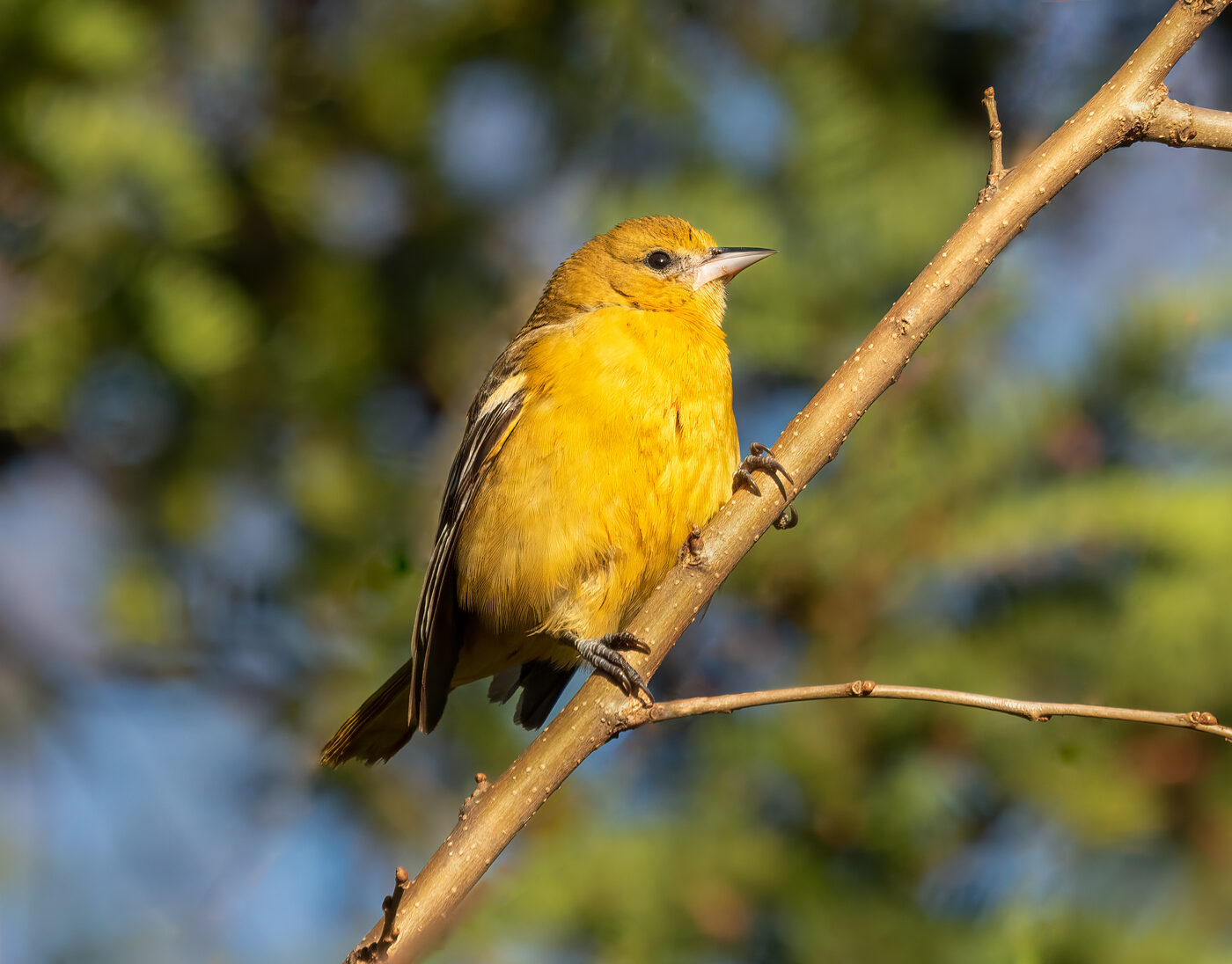
Hero image of Male Baltimore Oriole (Icterus galbula): Rhododendrites / CC BY-SA 4.0. Via Wikimedia Commons.
Magic Hedge, Montrose Point Bird Sanctuary: Via Wikimedia Commons.
Male American Redstart (Setophaga ruticilla): gailhampshire / CC BY 2.0. Via Wikimedia Commons.