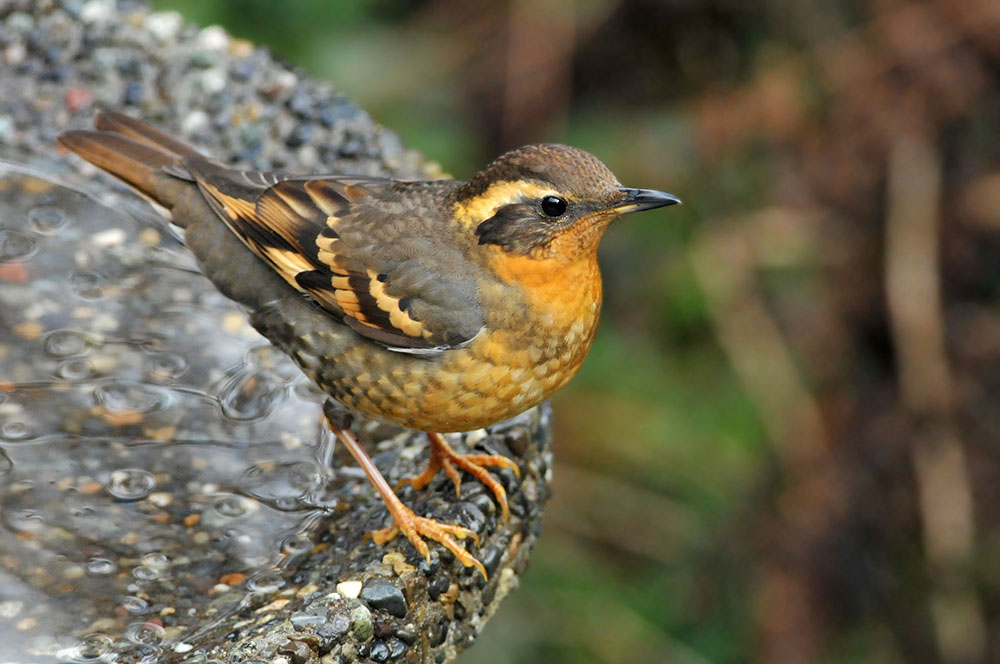
There is a sound you will never forget. A single, long, buzzing, almost electronic tone, rising, then falling, ringing through a cathedral of moss-draped Sitka spruce. That is the Varied Thrush, and it is the voice of the Pacific Northwest. Hear it once in the Hoh Rain Forest and you will understand why birders book flights to Washington just to stand still in the dripping green silence and listen.
The Olympic Peninsula and Mount Rainier together form one of the most ecologically diverse birding regions in North America. Old-growth temperate rainforest, subalpine meadows, volcanic glaciers, rocky alpine tundra: four completely different ecosystems within a few hours' drive of each other. This guide covers the three best trails across both destinations, drawing on eBird hotspot data and AllTrails reviews to tell you exactly where to walk, when to go, and what you'll find.
Why the Olympic Peninsula and Mount Rainier Are World-Class Birding Destinations
Washington's Olympic Peninsula is one of the wettest places in the continental United States. The Hoh Rain Forest receives 12–14 feet of rain annually, supporting the largest intact temperate rainforest in the Western Hemisphere: a place where centuries-old Sitka spruce and western red cedar are draped in so much moss that entire logs disappear under green. That ancient forest is everything to birds like the Marbled Murrelet, a seabird so specialized it commutes daily from the Pacific Ocean to nest on broad old-growth branches miles inland.
Mount Rainier, meanwhile, rises to 14,411 feet, a lone volcanic giant, and the Paradise and Sunrise meadows on its flanks are among the most accessible subalpine birding in the country. Species like White-tailed Ptarmigan and Gray-crowned Rosy-Finch breed in habitats found nowhere else in the region. Over 300 species have been documented on the Olympic Peninsula, and Mount Rainier National Park hosts 182 species. Together, they represent the full spectrum of Pacific Northwest birdlife. For a contrasting experience on the Atlantic Flyway, see our NYC birding trails guide, or discover the Great Lakes migration bottleneck in our Michigan Lower Peninsula guide. For Mississippi Flyway birding in a world-class urban setting, explore our Chicago & North Shore birding guide.
Trail 1: Hall of Mosses at Hoh Rain Forest, Olympic National Park
A flat loop through the finest old-growth temperate rainforest in the United States: enormous bigleaf maples draped in clubmoss, giant Sitka spruce, and a perpetually mist-shrouded understory. Walk slowly and listen: the birds here are often heard before they're seen. Best birding in the first hour after sunrise, when the forest comes alive with song.
The numbers on this trail are almost unbelievable: 4.9 stars from over 10,000 AllTrails reviews, near-unanimous praise, and yet most birders still arrive to find it blissfully quiet at dawn. The secret is simple: go early. The Hall of Mosses parking lot fills by 9 a.m. in summer, but the first hour after sunrise belongs to the birds.
The rainforest floor at Hoh operates on different rules than most birding environments. Light barely penetrates the canopy, the understorey is dense with ferns and oxalis, and sound travels strangely through the wet air. The Pacific Wren, one of the smallest birds in North America, produces one of the loudest and most complex songs on the continent, a rapid-fire cascade of trills and buzzes that seems impossible for a bird the size of a golf ball. Find one singing from a mossy log and you've had one of the best Pacific Northwest birding moments available.
Look up for Red-breasted Sapsucker drilling neat rows of holes in spruce bark; look at the canopy for Townsend's Warbler, a striking black-and-yellow bird that breeds in these same conifers. In the Hoh River corridor just south of the trail, scan for American Dipper, the only truly aquatic songbird in North America, bobbing on mid-river boulders and walking underwater to forage. And keep an eye on the sky at dawn and dusk: this old-growth forest is one of the few places the Marbled Murrelet still nests inland. If you see a chunky, fast-flying seabird rocketing through the canopy at dusk, that's what it is, making its commute from the Pacific, 30 miles west.
🦜 Species to Watch For at Hoh Rain Forest
💡 Pro Tip: Extend the Hoh experience by combining the Hall of Mosses with the adjacent Spruce Nature Trail (1.2 mi) for a 2.3-mile total loop along the Hoh River: the best stretch for American Dipper and Harlequin Duck. Arrive before 7:30 a.m. to beat parking congestion in July and August. Check the Olympic NP eBird region for recent Hoh sightings before your visit.

The Hall of Mosses, Hoh Rain Forest: bigleaf maples festooned in clubmoss, one of the most otherworldly birding environments in North America. Photo: via Wikimedia Commons, view source & license
Trail 2: Hurricane Hill via Hurricane Ridge at Olympic National Park
A ridge-top trail climbing through open subalpine meadows to a summit with 360-degree views of the Olympic Mountains, Strait of Juan de Fuca, and Vancouver Island. The paved road from Port Angeles to the Hurricane Ridge Visitor Center also offers excellent birding from pull-offs. Allow 2–3 hours for the full trail.
Hurricane Ridge sits at 5,242 feet: high enough for subalpine meadows and exposed ridgelines, low enough to be reached by a paved road from Port Angeles. That accessibility makes it one of the most productive mid-elevation birding sites in the Pacific Northwest, and the Hurricane Hill trail adds genuine wilderness solitude once you leave the visitor center behind.
The star attraction is Sooty Grouse, a large, dark grouse that inhabits the subalpine fir zone and is surprisingly confiding in early summer, when males hoot from low branches in a deep, ventriloquial series of booming notes. On the ridge itself, watch for Gray Jay (locally called Canada Jay) moving in family groups through the subalpine firs, bold, inquisitive birds that may land within arm's reach. Townsend's Solitaire sits atop exposed snags on the open ridge, singing its complex, warbling song from dawn to mid-morning.
The meadows along the trail host Horned Lark and the occasional Clark's Nutcracker in late summer, when the nutcrackers begin caching whitebark pine seeds for winter. Olive-sided Flycatcher calls persistently from dead snag tops: the quick-three-beers call is unmistakable. In late spring, Anna's Hummingbirds hover around the first wildflowers on the south-facing slopes below the visitor center.
🦜 Species to Watch For at Hurricane Ridge

Hurricane Ridge in Olympic National Park, where subalpine meadows and dramatic mountain views draw Gray Jays, Sooty Grouse, and roaming Black-tailed Deer. Photo: Ken Lund / CC BY-SA 2.0, view source
Trail 3: Skyline Loop at Paradise, Mount Rainier National Park
The most iconic trail in Mount Rainier National Park: a strenuous loop from Paradise (5,400 ft) up to Panorama Point (6,800 ft) with sweeping views of the Cascades, active glaciers, and subalpine wildflower meadows that peak in late July and August. Dogs not permitted. Allow 4–5 hours and start early to beat afternoon clouds.
The Skyline Loop is the closest most people will ever get to the truly wild, glaciated summit of Mount Rainier, and it is extraordinary birding. Starting at Paradise at 5,400 feet and climbing another 1,400 feet to Panorama Point, the trail moves through three distinct habitats: subalpine fir forest, open wildflower meadows, and rocky alpine terrain just below permanent snowfields.
The target species on the Skyline Loop are some of the most sought-after birds in Washington. White-tailed Ptarmigan, a grouse that turns pure white in winter and mottle-brown in summer, inhabits the rocky terrain above treeline. The Mount Rainier subspecies (Lagopus leucura rainierensis) is found only in the park and is listed as a species of concern. Scan rocky slopes carefully; these birds are masters of camouflage and often stay perfectly still as hikers walk within feet of them.
At Panorama Point and around the margins of the snowfields, watch for Gray-crowned Rosy-Finch, a hardy alpine specialist that nests on cliff faces and forages on the edges of snow for insects stunned by the cold. This is one of the most reliable spots in Washington to see them in summer. Clark's Nutcrackers range widely across the upper meadows, and Western Tanager and Hermit Thrush sing from the subalpine firs on the lower sections of the trail. In the parking lot at Paradise, Gray Jay is essentially guaranteed.
🦜 Species to Watch For at Skyline Loop, Rainier
💡 Pro Tip: Paradise regularly clouds over by noon in summer; start the Skyline Loop no later than 7:30 a.m. for the best views and the best birding. The section above Myrtle Falls and up toward Panorama Point is where the alpine specialists (ptarmigan, rosy-finch) concentrate. Check the Mount Rainier eBird region for recent Paradise sightings. Wildflower peak (and prime birding) is typically the last week of July through mid-August.

The Paradise meadows at 5,400 feet: wildflowers peak in late July, and Gray-crowned Rosy-Finches forage along the snowfield edges above Panorama Point. Photo: via Wikimedia Commons, view source & license
Best Times to Bird the Pacific Northwest: A Seasonal Guide
Washington's mild, wet climate means year-round birding opportunities, but the rhythms are different from the rest of the country. The Olympic Peninsula rarely gets truly cold, while Mount Rainier's high trails are buried in snow from November through June.
🌸 Spring (April–May)
Migrant warblers, Wilson's, Yellow, MacGillivray's, arrive on the Olympic Peninsula in May. Marbled Murrelets begin commuting to inland nesting trees at dusk. Mount Rainier's Paradise trail is typically still snowbound; Hoh and Hurricane Ridge are the stars.
☀️ Summer (June–August)
Peak season for all three trails. Skyline Loop at Paradise opens by late June. White-tailed Ptarmigan and Gray-crowned Rosy-Finch are reliably present at Panorama Point in July and August. Wildflowers peak in late July. Rainforest trails at Hoh are at their greenest.
🍂 Fall (September–October)
Clark's Nutcrackers move conspicuously through the subalpine zone caching seeds. Vagrant waterbirds appear on coastal Olympic Peninsula beaches. The rainforest fills with wintering Varied Thrush arriving from higher elevations. First snowfall typically closes Paradise road by late October.
❄️ Winter (November–March)
Hurricane Ridge occasionally opens for snowshoeing: Sooty Grouse and Gray Jay remain. Hoh Rain Forest is spectacular in winter rain with no crowds; Varied Thrush and Pacific Wren are year-round. Coastal spots like Ediz Hook in Port Angeles host Harlequin Ducks and Marbled Murrelets on the water.
FAQ: Pacific Northwest Birding
What is the most iconic bird of the Pacific Northwest rainforest?
The Varied Thrush is the signature sound of the Olympic Peninsula's old-growth rainforest, a long, haunting, single-note buzz that echoes through the Hoh and Quinault rain forests from October through June. Visually, the male is stunning: slate-gray above with a bold burnt-orange breast and a distinctive dark breast band. The Hall of Mosses at Hoh Rain Forest is one of the most reliable locations in North America to hear and see them at close range.
Where can I see White-tailed Ptarmigan at Mount Rainier?
The section of the Skyline Loop above Panorama Point (above 6,500 ft) is the most reliable spot, particularly on the rocky slopes just below the permanent snowfields. They're also frequently seen near the Skyline Trail above Myrtle Falls. Ptarmigan are extremely well-camouflaged and often stay still as hikers approach; scan rocks carefully rather than scanning the sky. Late July and August are the best months, when the trail is fully snow-free.
Do I need a national park pass for these trails?
Yes for all three. Olympic National Park and Mount Rainier National Park both charge entrance fees, and an America the Beautiful annual pass ($80) covers both and pays for itself in two visits. The Hoh Rain Forest visitor area charges a vehicle fee. Hurricane Ridge charges an entrance fee at the park boundary near Port Angeles. All fees support trail maintenance and wildlife programs.
What birding gear is recommended for the Pacific Northwest?
Waterproof binoculars matter here more than anywhere: the Hoh Rain Forest averages 140 inches of rain per year. A rain jacket is essential year-round. For the Skyline Loop at Rainier, bring layers even in August; temperatures at Panorama Point can be 20–30°F colder than Paradise. The free Merlin Bird ID app (Cornell Lab) includes sound ID, which is invaluable in the dense rainforest where birds are often heard but not seen.
More Trail Guides
- Chicago & North Shore Birding: Montrose Point, Skokie Lagoons & Illinois Beach SP on the Mississippi Flyway
- NYC Birding Trails: Central Park, Prospect Park & Jamaica Bay on the Atlantic Flyway
- Michigan Lower Peninsula Birding: Kirtland's Warbler tours, Tawas Point & Sleeping Bear Dunes on the Great Lakes
Get the Next Guide in Your Inbox
New regions drop every few weeks. Subscribe and never miss a trail guide.
Subscribe Free →📷 Photo Credits
Hero image of Varied Thrush (Ixoreus naevius), female, Washington: Via Wikimedia Commons.
Hall of Mosses, Hoh Rain Forest: Via Wikimedia Commons.
Rainier Meadow, Mount Rainier: Via Wikimedia Commons.